
For years, organisations have talked about digital transformation, automation and smarter workflows. Yet the real competitive advantage in 2026 is not the technology itself. It is the quality of the operational data that flows through a business every day.
Firms across engineering, architecture, consulting, construction, legal and IT services now operate in environments where client expectations are higher, timelines are tighter and margins are thinner. In this landscape, data quality is no longer a back-office concern. It is a direct driver of performance, profitability and long-term stability. Organisations that get it right gain a structural advantage over those still operating on inconsistent, delayed or incomplete information.
This article explains why data quality matters more than ever, how poor data silently harms organisations and how Quantim gives teams a clear, reliable and actionable operational foundation.
What Data Quality Really Means in Operational Work
Data quality is not about having more data. Every organisation generates vast amounts of operational information every day. The question is not volume. It is whether that data is accurate, timely, consistent, complete, structured and actionable. Poor data quality is not the absence of data. It is the presence of data you cannot trust, and that is often more dangerous than having no data at all because it creates false confidence rather than honest uncertainty.
In project-based industries, high-quality data flows from daily operational activities: time tracking, timesheets, job costing, utilisation reporting, expense recording, progress updates, approvals, forecasting, fee raising and work in progress reporting. When these data points are clean and reliable, organisations gain a complete picture of how work is being delivered, how money is being spent and where performance is trending. When they are not, every decision downstream from that data is built on an unstable foundation. Strategy, resourcing, billing and forecasting all degrade together, and the source of the problem remains invisible because the numbers still look like numbers.
How Poor Data Quality Silently Damages Organisations
Many firms believe they have a performance problem, a resourcing problem or a profitability problem, when in reality they have a data quality problem. The impact is often invisible until it becomes expensive, because the consequences of poor data accumulate quietly across multiple systems before they surface as a visible crisis.
Unreliable Forecasting
Forecasting depends on accurate hours, spend, progress, job performance and pipeline activity. When any of these inputs are incomplete, delayed or inconsistently captured, the forecast built on them becomes a work of informed fiction rather than genuine prediction. Leaders make decisions based on numbers that do not reflect operational reality. Budgets drift from their original basis, revenue targets become disconnected from what is actually being delivered and cash flow becomes unstable in ways that feel sudden but were entirely predictable.
The compounding effect is significant: a forecast built on poor data leads to poor resource allocation decisions, which leads to further delivery problems, which further degrades the data quality of the next forecasting cycle. Organisations that have never had reliable forecasting often do not realise how much strategic capacity they are losing to this loop. The detail of what a genuinely reliable forecasting system requires is explored in our article on building a forecasting system for financial control.
Weak Cost Control
When expenses and job costing entries are incomplete, incorrectly coded or delayed, the cost picture becomes unreliable in ways that directly damage profitability. Rework goes unnoticed because the hours are coded to the wrong activity. Reimbursable expenses are missed because they were never entered or linked to the correct job. Profit leakage increases because the gap between actual cost and billed value is never surfaced clearly enough to trigger action. Work in progress becomes inaccurate, project performance appears better or worse than it actually is and the organisation loses the ability to intervene before a job becomes unprofitable.
The relationship between clean expense data and genuine cost control is detailed in our article on expense analysis for project cost control and profit growth, which covers how structured expense capture translates directly into better job-level financial decisions. Cost control does not start with analysis. It starts with clean data.
Inconsistent Utilisation Interpretation
Utilisation is one of the most important operational metrics in any professional services firm, and it is one of the most frequently distorted by poor data quality. When timesheets are incomplete, submitted weekly or monthly in bulk, or poorly categorised across jobs and activities, the utilisation figures that result are misleading in unpredictable ways. Teams appear overloaded or underutilised when neither is accurate. Resourcing decisions, hiring plans, workload distribution and staff wellbeing all suffer as a consequence.
The specific ways in which time tracking data quality fails in engineering and technical teams, and what the operational cost of that failure looks like, are examined in our article on why time tracking fails in engineering teams. The core insight is consistent: poor time data does not just produce bad utilisation reports. It corrupts every downstream decision that depends on knowing where capacity actually is.
Slower Decision Making
Leaders hesitate when they do not trust their data. This hesitation has a direct operational cost that is rarely quantified but consistently felt. Managers wait for revised spreadsheets before committing to a resource allocation. Finance waits for corrected timesheet numbers before raising an invoice. Operations waits for clarifications before updating a forecast. Each delay is individually small. Collectively, they slow the entire decision-making rhythm of the organisation.
The shift from slow, uncertain decision making to fast, confident decision making is not primarily a cultural change. It is a data quality change. When the numbers can be trusted, decisions accelerate because the conversation moves from validating the data to acting on it. Our article on moving from guesswork to clarity explores how this transition changes the operational tempo of project-led businesses.
Declining Client Confidence
Clients expect accurate reporting, justified fees, transparent progress and predictable delivery. These expectations have risen significantly as professional services markets have become more competitive and clients have become more sophisticated about what good project management looks like. When firms submit reports, invoices or progress updates based on weak or inconsistent data, clients notice. Trust declines, disputes increase and long-term relationships weaken in ways that are difficult to recover from.
Data quality is therefore not only an internal operational concern. It is a client-facing commercial asset. Firms that can demonstrate accurate, consistent and transparent reporting differentiate themselves in a market where unreliable delivery is common and genuine operational clarity is rare.
The Hidden Cost of Living With Poor Data
Most organisations that have a data quality problem do not know they have one. They experience its symptoms instead: projects that are unexpectedly unprofitable, forecasts that are consistently optimistic, invoices that are disputed, resource decisions that seem logical but produce the wrong outcomes, and a persistent sense that the business is working harder than the results justify.
Revenue leakage is one of the clearest financial symptoms. Hours that are worked but never correctly attributed to a billable job, expenses that are incurred but never linked to a client account, variations that are delivered but never formally raised: each of these represents money that the business earned but never recovered. In isolation, each instance is small. Across a portfolio of active jobs and a team of twenty or thirty professionals, the cumulative figure is routinely significant.
Operational intelligence, the ability to see what is actually happening across the business in real time, is only possible when the underlying data is reliable. Firms that invest in data quality do not just get better reports. They get the ability to act on those reports with confidence, which is the thing that actually changes outcomes. Those that continue operating on poor data are essentially managing by feel, and the cost of that approach grows as the organisation scales because every new job, client and team member adds another layer of untracked uncertainty.
Why Data Quality Has Become a Competitive Advantage
Industries are becoming more complex, not less. Competition is intensifying across every professional services sector. Clients are making procurement decisions based on factors that go beyond price and technical capability. Increasingly, the ability to demonstrate operational transparency, forecasting accuracy and delivery consistency is what distinguishes firms that win work from firms that lose it.
Data quality determines whether organisations win work or lose it, retain clients or damage those relationships, grow profitably or operate with eroding margins, and scale their operations or remain trapped in manual processes that cannot support growth. The firms that have made data discipline a strategic priority are not simply better organised. They are structurally more competitive because every part of their operation runs on information that can be trusted.
The concept of data discipline as a hidden strategic skill in project-led companies, and what it takes to build it consistently across a growing organisation, is the focus of our article on data discipline as the hidden skill in project-led companies. The core argument is that digital transformation ROI is not delivered by new tools alone. It is delivered by the quality of the data those tools are fed, and by the habits that ensure that quality is maintained every day.
How Quantim Strengthens Data Quality Across the Organisation
Quantim is designed to give organisations daily operational data that is accurate, structured and instantly usable without adding administrative burden. The platform builds data quality naturally into the way work is recorded, approved and reported, so the information that reaches dashboards and financial systems is reliable by the time it gets there rather than requiring correction after the fact.
Structured Time Tracking
Quantim standardises how time is captured across the organisation. Activity-level detail, clear job selection, daily entry prompts, utilisation updates and real-time validation ensure that timesheet data is complete, correctly attributed and immediately usable for job costing, utilisation reporting and forecasting. Time tracking becomes reliable operational intelligence rather than a retrospective administrative exercise that produces numbers nobody fully trusts.
Clean Expense and Cost Data
Expenses follow a structured entry flow with guided categorisation, receipt uploads, VAT rule application, job linking and approval checks. Every expense entered becomes a trusted data point that contributes to job costing accuracy, fee billing completeness and financial reporting reliability. The discipline of structured expense capture is what prevents the revenue leakage that accumulates when costs are recorded informally or after the fact.
Real-Time Progress and Job Performance Updates
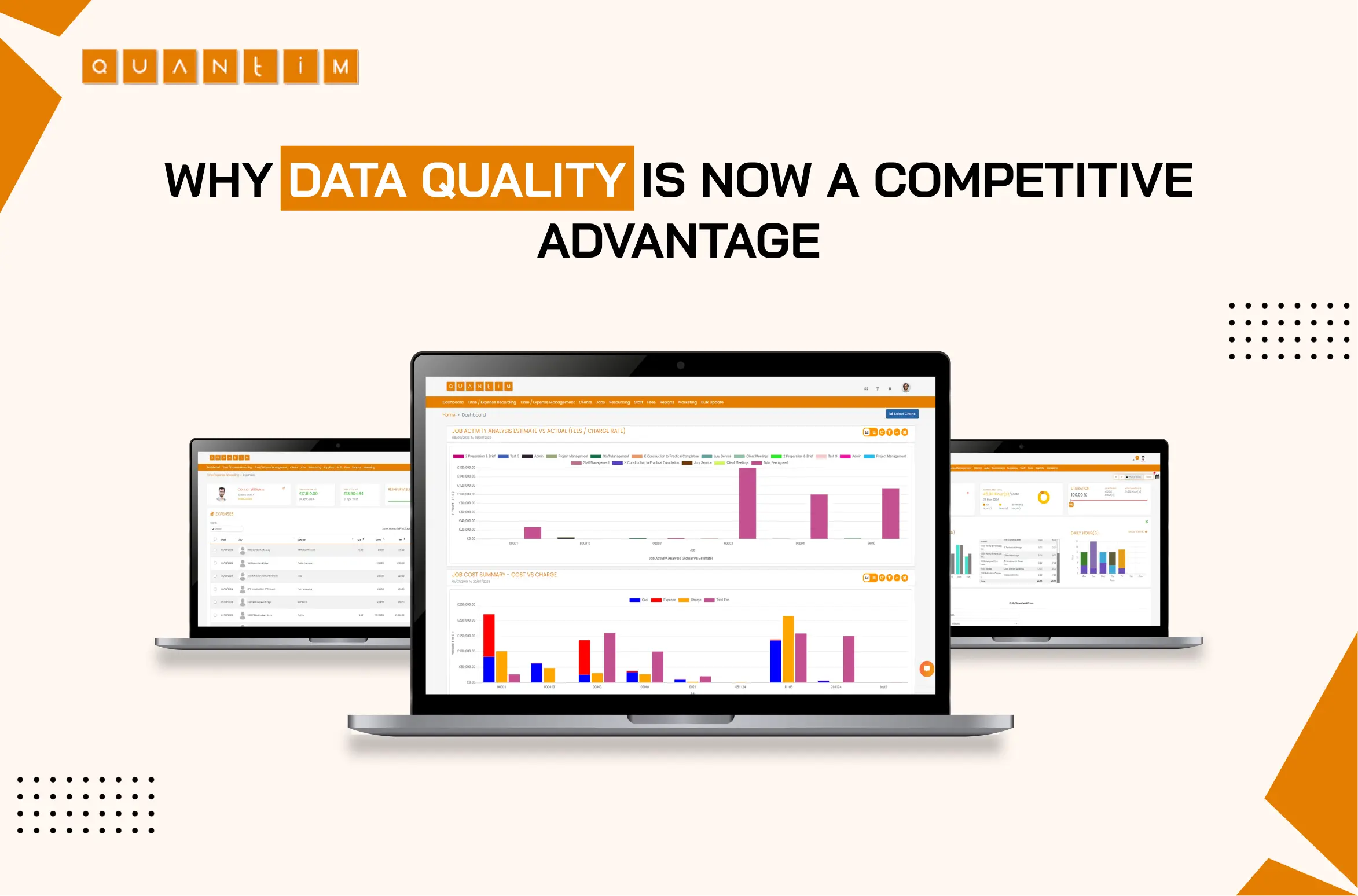
Quantim connects time, activities, fees and work in progress to live performance indicators: actual vs estimate, job activity analysis, cost vs recovery, remaining to invoice and forecast to complete. These are not static reports generated at month end. They are live indicators that update as work is recorded, giving managers a single source of truth for job performance that is accurate at the moment it is needed rather than accurate as of last Friday.
Approvals That Ensure Data Consistency
Quantim prevents poor data from entering the system before it can corrupt downstream reporting. Approvals, rules, validations and permission controls create a structured data entry environment where the information that reaches finance and leadership dashboards has already been reviewed and confirmed at the operational level. Data integrity is maintained at the point of entry, not corrected after the damage has been done.
Forecasting Supported by Live Operational Data
Because Quantim connects daily activity with financial models in real time, forecasts improve continuously rather than being rebuilt manually each month. Work in progress becomes more accurate as hours and expenses update automatically. Revenue expectations become grounded in what is actually being delivered rather than what was hoped for at the start of the period. Financial risk reduces because the gap between the forecast and reality shrinks when both are drawing from the same live data.
Dashboards That Update Instantly
Quantim dashboards display real-time utilisation, job cost status, forecasting, progress trends, expenses, approvals and KPIs without any manual consolidation. Leaders see the state of the business as it is right now, not as it was when someone last compiled a report. This removes the dependency on manual reporting cycles and eliminates the version-control problems that arise when different teams are working from different spreadsheet snapshots of the same operational reality.
Conclusion: Better Data Creates Better Organisations
Data quality is no longer an internal technical issue handled by someone in the back office. It is a strategic advantage that determines whether an organisation can forecast accurately, manage costs reliably, make decisions quickly and maintain the client trust that sustains long-term growth.
Strong data quality improves performance across every function: delivery, finance, resourcing, business development and client management. Quantim helps organisations achieve this by transforming everyday operational activity into consistent, structured and real-time insight that leaders can act on with confidence.
The next step is understanding how that data translates into smarter decisions at every level of the organisation. Our article on the role of analytics in smarter project decisions covers how clean operational data, properly surfaced, changes the quality and speed of every decision from individual task management to portfolio-level strategy.
If you want to improve operational clarity and data accuracy across your organisation, contact us at info@quantim.co.uk or book a demonstration below.