
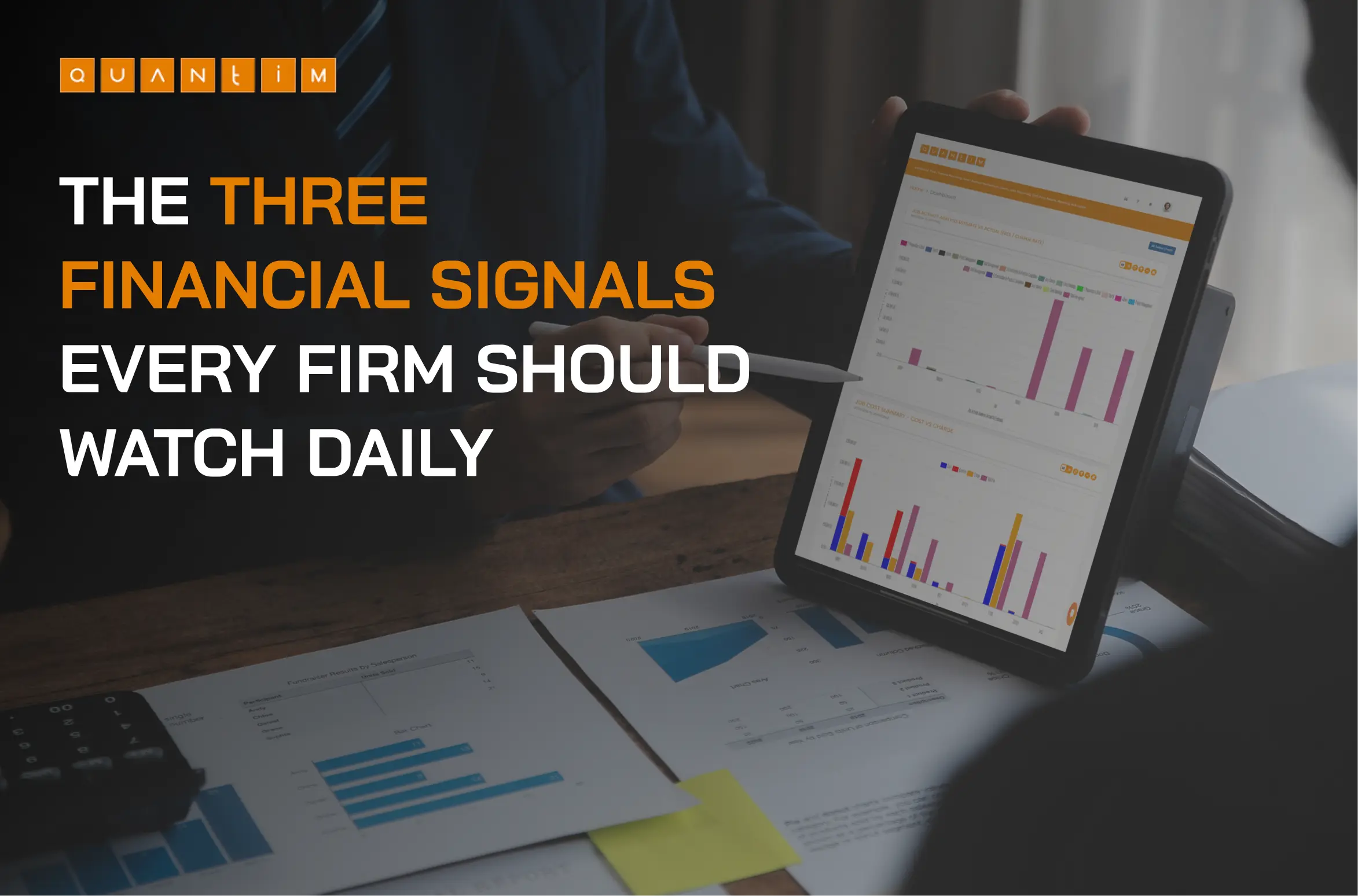
Strong financial performance does not come from annual audits or month-end reviews. It comes from understanding what is happening in the business every single day.
Daily financial signals reveal early risk, highlight operational drift and give leaders the clarity to protect margins before problems escalate. Across engineering, architecture, consulting, construction, IT and other project-based industries, firms lose profitability not through major events but through small daily movements that go unnoticed until the damage is already done.
This article explains the three financial signals that matter most, why they influence profitability and how Quantim helps firms monitor them with confidence.
1. Planned vs Actual Time: The First Indicator of Financial Drift
Time is the earliest and most reliable signal of financial health. Most project issues begin long before invoices, expenses or variation claims appear. They begin when teams take longer than estimated, activities expand beyond the original scope, rework appears in small increments, workload becomes uneven or utilisation drops below expectations. Daily time tracking highlights these deviations immediately, before they become expensive to correct.
Inaccurate or delayed time entry damages job costing, margin expectations, forecasting accuracy, work in progress, project schedules and resourcing decisions simultaneously. A fifteen-minute deviation repeated across a team over several weeks results in significant financial drift that no month-end report will catch early enough to address.
When leaders consistently compare planned hours, actual hours, daily utilisation and activity progress, they gain the ability to intervene early. This is the foundation of what job activity analysis makes possible for every project manager: catching the gap between expected effort and real effort while there is still time to act on it.
Quantim provides real-time visibility of hours booked today, weekly utilisation, activity breakdown, job progress against estimate and rework indicators. This transforms timesheets from an administrative obligation into a daily financial intelligence tool.
2. Cost vs Recovery: The True Measure of Project Financial Health
Many firms focus on revenue alone, yet revenue means little without understanding recovery. Recovery is the relationship between what a job costs to deliver and what the firm actually earns from it. In most organisations, poor recovery is the silent cause of profit leakage, inaccurate billing, overstated revenue expectations, strained cash flow and weak forecasting.
Daily cost signals include expense bookings, reimbursable costs, subcontractor spend, job-level cost accumulation, cost against budget and variance between actual cost and chargeable value. When these figures update weekly or monthly rather than daily, it is already too late to influence the outcome for jobs that are actively being delivered.
As explored in our analysis of why activities fail even with a perfect schedule, the same forces that cause schedule drift, scope expansion and untracked rework also drive cost overruns. Monitoring cost vs recovery daily exposes projects trending towards loss, clients with poor payment patterns, activities consuming more time or cost than planned, the need for variations or scope alignment and potential billing risks before they crystallise.
Quantim connects expenses, time, activities and fees to show real-time cost vs recovery, job cost summaries, actual vs estimated hours, remaining to invoice and profitability trends in a single operational view.
3. Forecast vs Performance: The Predictor of Future Profitability
Forecasting is not a financial formality. It is a risk detection system. Daily monitoring of forecast movements shows whether expected revenue is still achievable, planned billing is realistic, fee recovery remains on track, work in progress is accurate and cash flow expectations need adjustment. Firms that rely on month-end forecasting operate reactively rather than proactively, and they consistently discover problems later and at greater cost.
Forecasts shift daily because of new expenses, timesheet updates, delayed approvals, scope changes, variations raised or pending, slower progress on tasks and client-side delays. Daily forecast signals include forecasted fees against raised fees, expected vs actual progress, remaining to bill, job margin percentage, fee recovery outlook and variance from the baseline fee model.
The connection between accurate forecasting and confident business growth is explored in depth in our article on smart resource forecasting, which covers how firms that plan resource requirements against live pipeline consistently outperform those managing capacity on outdated assumptions. Quantim updates forecasts automatically when time is booked, expenses are approved, progress changes, new fees are raised or variations are introduced, giving a complete and accurate financial picture without manual consolidation.
Why These Three Signals Matter More Than Anything Else
Together, these three daily signals form the foundation of sustainable profitability. Time tells you what is happening right now: efficiency, utilisation, progress and early drift. Cost vs recovery tells you whether the work is financially healthy, highlighting leakage, cost overruns and poor financial alignment. Forecast accuracy tells you where the organisation is heading, showing future revenue, cash flow and job-level financial stability.
Firms that monitor these signals daily outperform those that react monthly. They make faster decisions, protect margins earlier and deliver projects with greater accuracy and fewer surprises.
How Quantim Brings These Signals to Life in Real Time
Most platforms claim to offer financial dashboards, but very few deliver information at the speed and clarity required for daily decision making. Quantim transforms operational data into meaningful financial signals through a series of live dashboards that managers rely on every morning. The elements that make these dashboards genuinely useful are covered in our guide to what high-performance project dashboards must include.
Time Signal in Action: Actual vs Estimated Hours
Quantim visualises daily time accuracy through the Actual vs Estimated Hours chart, allowing managers to see whether the job is running ahead or behind plan, where estimated hours were too optimistic, which activities are absorbing more effort than expected and early signs of rework or inefficiency. Instead of waiting for month-end reports, leaders can identify drift within days, protecting budgets and preventing tasks from overrunning silently.
Cost Recovery Signal in Action: Live Fee Charts
Quantim displays the financial health of ongoing work through real-time indicators covering total forecast, total billed, total paid and total profit. Because these figures update automatically as progress, time and invoices change, teams always know whether billing is keeping pace with delivery, whether cash collection is overdue, whether profit is trending up or down and how actual work compares to financial expectations. This converts financial visibility from a backward-looking report into a live operational control layer.
Revenue Signal in Action: Remaining to Invoice vs Forecast
One of the strongest predictors of cash flow is the amount of earned value still waiting to be invoiced. Quantim's Remaining to Invoice by Client chart highlights which clients hold the largest unbilled amounts, whether invoicing is aligned with progress, gaps between expected revenue and actual billing, and accounts where delays may turn into revenue risk. Firms often underestimate how much money is locked in pending billing. Quantim exposes this immediately so billing stays disciplined, consistent and predictable.
Role-Based Access: Financial Signals with Control
Not every user needs every financial metric. Quantim applies structured access levels so the right people see the right signals: finance sees revenue, payment and profit indicators; project managers see time, utilisation and progress data; directors see the complete financial outlook; and staff see only their own work input. This avoids confusion, protects sensitive financial data and keeps each dashboard relevant to the decisions each role actually needs to make.
Why These Dashboards Strengthen Financial Confidence
Because Quantim updates every signal in real time, firms gain earlier visibility of drift, higher billing accuracy, more disciplined cost management, stronger cash flow control, reduced leakage and more reliable forecasting. Leaders no longer make decisions based on outdated information. They see what is happening today, not what happened weeks ago.
Conclusion
Success in project-based organisations is determined not by annual audits or quarterly reviews but by the small daily signals that shape performance. Time, cost and forecast indicators are the earliest warnings of financial risk and the strongest sources of operational confidence.
Organisations that track these signals daily operate proactively, deliver better results and protect profitability more effectively. The daily disciplines that underpin this approach are set out in our daily tracking framework for high-performing teams, which covers how consistent visibility habits translate directly into stronger delivery outcomes.
If your firm wants to strengthen financial visibility and eliminate blind spots, contact us at info@quantim.co.uk or Book a Free Quantim Demo.