
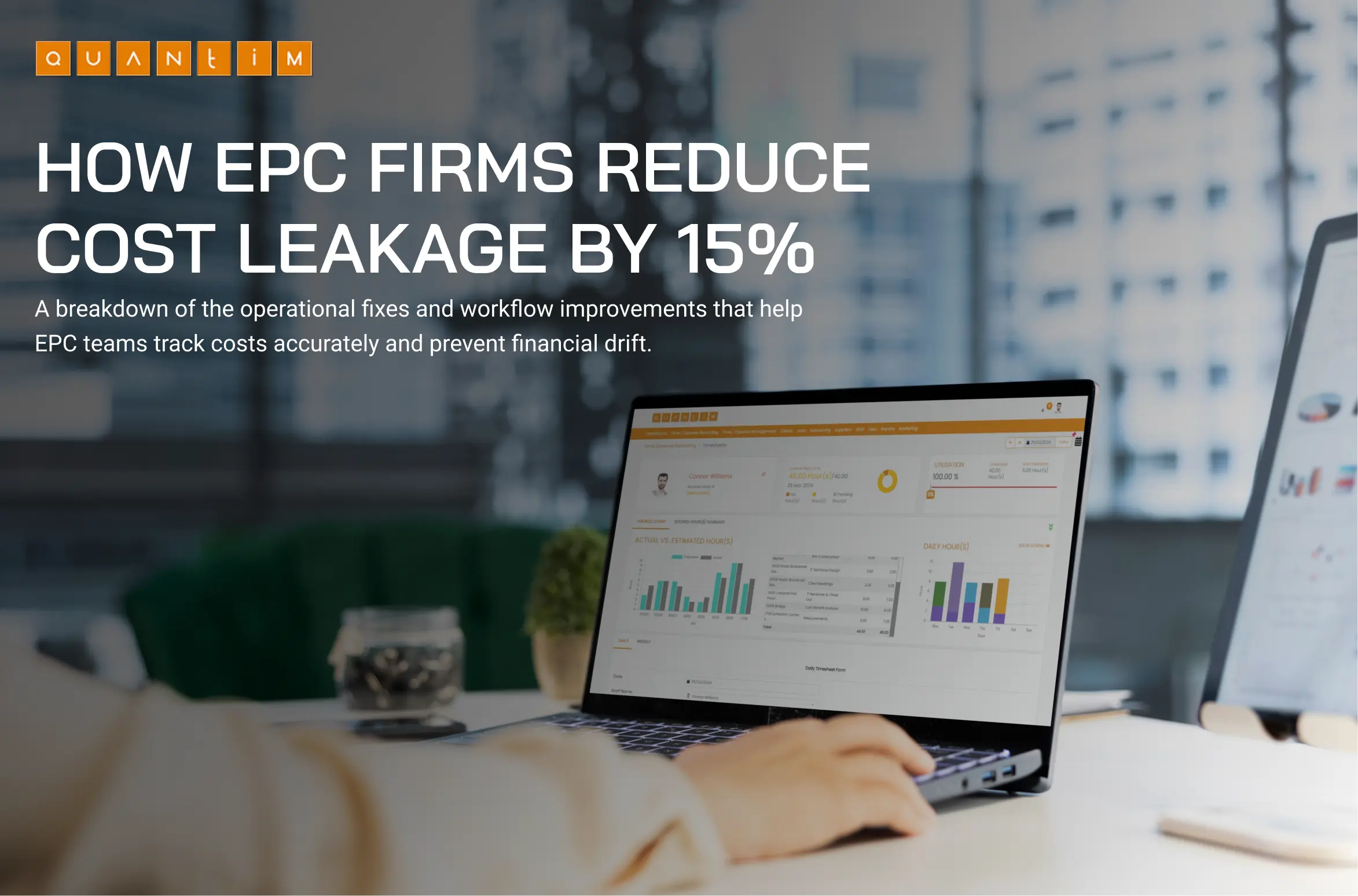
Cost leakage is one of the most significant operational and financial challenges in the EPC (Engineering, Procurement and Construction) sector. It does not appear as a single event. It arises from hundreds of daily decisions, undocumented updates and disconnected workflows that individually seem manageable but collectively create serious financial exposure. Studies across the industry consistently show that leakage reaches 10 to 25 percent of total project cost when organisations rely on fragmented systems and manual processes.
Most EPC firms experience the same recurring pattern across multiple projects. Budgets and schedules are well structured at the outset, yet maintaining real control over actual cost performance becomes increasingly difficult once execution begins. Delayed reporting, inconsistent field updates, manual spreadsheets and disjointed communication create blind spots that make financial drift almost impossible to detect early enough to correct.
EPC firms that have adopted structured cost control frameworks, supported by digital systems such as Quantim, have reported measurable reductions in leakage, often achieving improvements of up to 15 percent within their first year. These gains come from stronger visibility, tighter workflow discipline and operational alignment across every stage of the project lifecycle. Below is a breakdown of the five operational areas where leakage most commonly occurs and how organisations are addressing them.
10–25%
Typical cost leakage in EPC projects using fragmented systems and manual processes
Up to 15%
Leakage reduction reported by EPC firms in their first year using structured digital cost control
5 Areas
Core operational gaps where leakage originates: data capture, visibility, variations, rework, fragmentation
1. Standardising Operational and Financial Data Capture
One of the strongest root causes of leakage is inconsistency in how teams record information. EPC projects involve designers, engineers, procurement teams, planners, subcontractors, supervisors and commercial managers, each with their own working practices. When each group captures data differently, financial clarity breaks down. Timesheets are recorded late or with vague descriptions. Field updates arrive via chat apps with no structured format. Procurement records are spread across multiple spreadsheets. Variations are handled informally. Rework goes unlogged. Progress is measured differently by different departments. The result is fragmented cost data that cannot be analysed with any confidence.
The fix is to implement standardised data capture processes that define the same rules for everyone: daily time recording requirements, clear activity and cost code categories, standard templates for progress reporting, documented variation logs and consistent procurement record keeping. Quantim provides predefined structures for time entry, progress updates, variations, rework, procurement and WIP that ensure all data across the organisation follows the same format, producing clean, comparable and financially reliable information from every team on every project.
2. Establishing Real Time Visibility Instead of Retrospective Discovery
Most EPC organisations detect leakage too late because cost reviews happen weekly or monthly. By the time overspend appears in a report, weeks of financial drift have already occurred and the options for recovery are limited. The gap between when a cost problem starts and when it is reported is where leakage grows. Closing that gap requires moving from periodic reporting to live cost visibility.
Real time visibility enables teams to spot cost overruns on the day they begin, compare actual hours against budget instantly, view live progress at job and activity level, and receive alerts when thresholds are exceeded. Quantim synchronises field updates, labour records, cost data, variations and progress into a single dashboard that leadership can view at any moment. The shift this creates is from reactive cost management, where problems are discovered after they have occurred, to proactive control where teams act on current information before drift becomes overrun.
The reporting gap: If your cost review cycle is weekly, you have up to seven days of undetected drift on every active project. On a large EPC programme, that window compounds across dozens of workstreams simultaneously.
3. Introducing Structured Change and Variation Management
Scope drift is one of the largest contributors to leakage in EPC projects. Changes happen constantly in design, installation, procurement and execution, yet many organisations fail to document these adjustments with the rigour the commercial risk requires. Changes are completed without approval. Additional work is absorbed into existing budget without being costed separately. Client requests go untracked. Time spent on modifications is not recorded. The impact on timelines is not communicated. These gaps do not just create cost leakage; they create the conditions for commercial disputes.
Structured change control requires that every change request is captured, its impact on time, cost and scope is documented, approval is obtained before work continues, and the change is linked directly to the relevant cost codes and work packages. Quantim provides a complete variation management workflow where every change is logged, costed, timestamped and connected to the corresponding project activity, giving commercial teams full transparency and traceability across the entire change history of a project.
| Without Variation Management | With Structured Change Control |
|---|---|
| Unapproved changes Work proceeds on verbal instruction with no cost or programme impact assessed. | Approved before execution Every change is formally reviewed, costed and approved before any resource is committed. |
| Absorbed costs Additional scope is absorbed into existing budget, hiding true project performance. | Separately costed Changes are coded and tracked independently, keeping baseline budget reporting accurate. |
| Disputed variations Undocumented changes become the source of client disputes and delayed payments. | Full traceability Timestamped records provide an auditable trail for every variation across the project lifecycle. |
4. Making Rework Visible Instead of Hidden
Rework is unavoidable on complex EPC projects, but unmanaged rework is one of the largest hidden sources of cost leakage in the sector. When errors occur, field teams correct them quickly to keep work moving. The time spent fixing the problem rarely gets recorded because logging it feels like an admission of failure or an unnecessary administrative step under pressure. The consequence is that the cost of rework disappears into normal labour hours, distorting productivity data and preventing organisations from understanding how much of their budget is being consumed by avoidable inefficiencies.
The practical fix is to classify rework as a measurable cost item with its own category in the time recording system. Teams log rework hours, record the cause, and link the entry to the responsible activity. Over time this data reveals patterns: which design issues are generating repeat corrections, which teams or suppliers are producing substandard first-pass quality, and where process improvements would have the greatest financial return. Quantim provides a rework tracking module that captures time, cost and root causes so organisations can move from absorbing rework costs silently to eliminating their underlying causes systematically.
5. Unifying All Operational Data into One Platform
Fragmentation is the structural cause of most leakage. EPC organisations frequently manage projects using a combination of spreadsheets, ERP modules, email threads, messaging apps, field notebooks and legacy systems that do not communicate with each other. Information is scattered, duplicated, delayed or simply lost. Each individual tool may work adequately in isolation, but the gaps between them are where cost control breaks down. No single person has a complete picture. Financial decisions are made on incomplete data. Problems are identified late because the signals are spread across systems no one has the time to reconcile.
Unifying project, field and financial data into a single platform removes those gaps. Quantim serves as the operational backbone for EPC organisations by integrating time and labour tracking, job and activity level progress, procurement and cost control, field reporting, variation management, WIP calculation and forecasting into one environment. When every team works from the same system, data is captured once, verified centrally and available immediately to whoever needs it. The result is not just better reporting; it is a fundamentally different level of operational control.
- ✓ Time and labour tracking against specific jobs, activities and cost codes.
- ✓ Live progress measurement at job and activity level across all active projects.
- ✓ Procurement and cost control with consistent coding across the organisation.
- ✓ Field reporting with photographic and documentary evidence attached to activities.
- ✓ Variation and approval workflows with full timestamped audit trail.
- ✓ WIP calculation and forecasting driven by live data rather than manual estimates.
Why Many EPC Firms Achieve 15 Percent Leakage Reduction with Quantim
The 15 percent figure is not a marketing claim; it reflects what happens when the specific operational gaps that cause leakage are closed simultaneously. Inconsistent time entry is replaced by standardised daily recording. Untracked variations are replaced by a documented approval workflow. Undocumented rework is replaced by a categorised cost item. Poor progress measurement is replaced by live activity-level data. Manual WIP calculations are replaced by system-generated figures. Fragmented communication is replaced by a single shared platform.
Each of these changes produces a measurable improvement in cost accuracy. Together, they transform the financial discipline of the organisation. EPC firms that have made this transition describe the change not just in terms of reduced leakage, but in terms of the quality of commercial decisions they are now able to make. When leaders have access to accurate, current data across all projects, the conversations they have with clients, subcontractors and their own teams are fundamentally different.
Conclusion
Cost leakage in EPC delivery grows quietly when organisations rely on fragmented tools and inconsistent processes. It does not announce itself. It accumulates through small operational gaps that individually seem acceptable but collectively drain project profitability at a scale that most organisations would not tolerate if they could see it clearly. Standardising data capture, achieving real time visibility and introducing structured cost control workflows are the operational changes that close those gaps.
The organisations that address these issues systematically, rather than project by project, build a financial discipline that compounds over time. Each project generates cleaner data. Each dataset improves forecasting accuracy. Each improvement in forecast accuracy reduces the buffer cost that organisations carry to manage uncertainty. That progression, from reactive cost management to predictive financial control, is what the 15 percent leakage reduction represents in practice.
To find out how Quantim supports EPC cost control across time tracking, variation management, rework visibility and project reporting, book a free demonstration or contact the team directly at info@quantim.co.uk.