
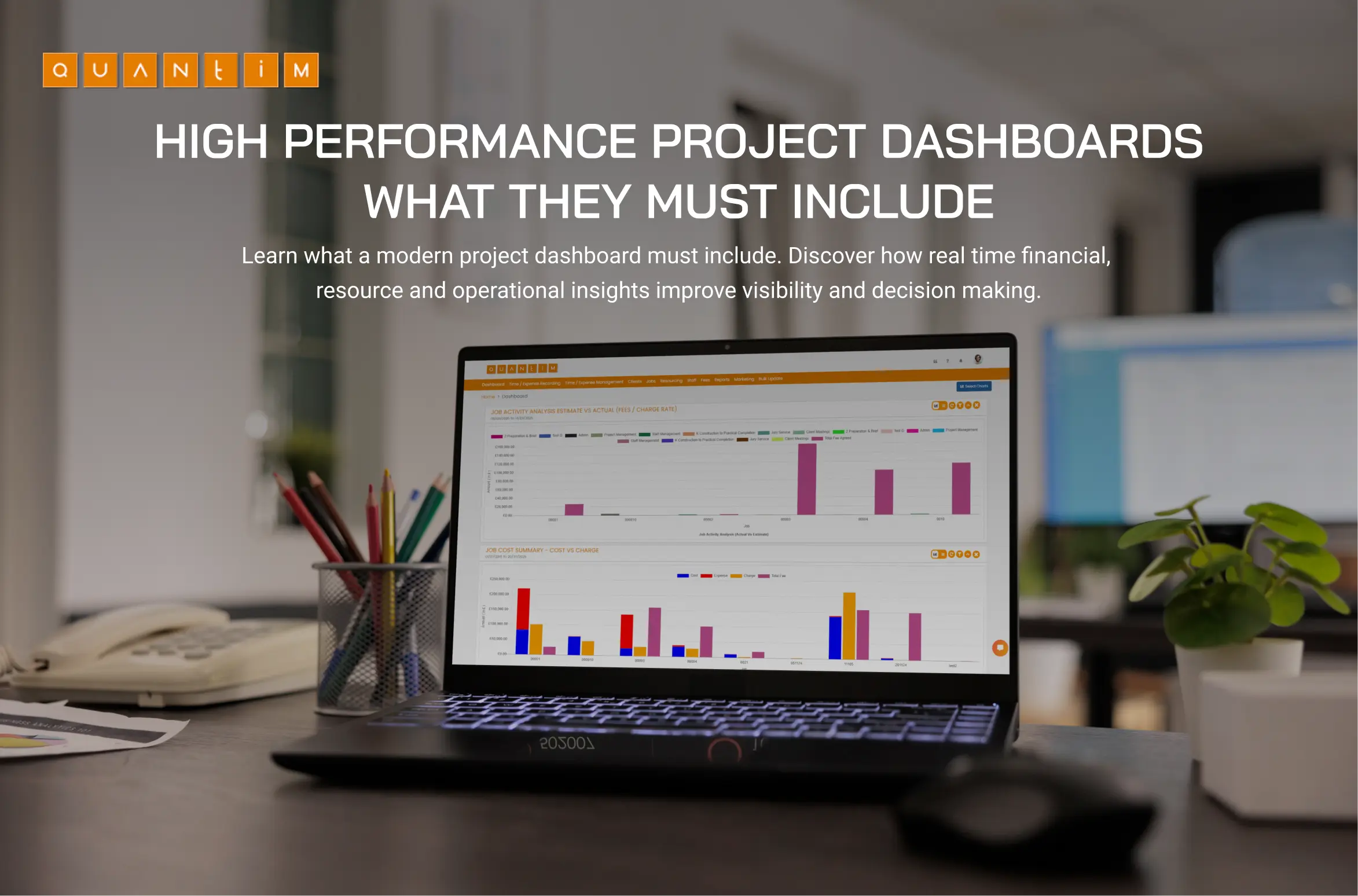
A dashboard is the decision centre of every modern organisation. It is the place where performance becomes visible, where risks surface early and where managers understand the real state of projects, resources, revenue and workload. Yet many firms still operate with dashboards that look attractive but fail to deliver meaningful insight. They show data without context, present historical information as if it were current and provide the same view to every user regardless of whether that view serves their decisions.
A well-designed dashboard is not a visual layer applied on top of operational data. It is a strategic tool that connects information from time tracking, expenses, resources, fees, forecasting, staffing and project progress into one coherent and continuously updated picture. When built correctly, it helps senior leaders, project managers, operational teams and finance teams make faster and more confident decisions based on what is actually happening today rather than what was reported last week.
This article explores what a high-performance project dashboard must contain, why each element matters and the results organisations gain when they move from surface-level reporting to genuine operational intelligence. At the end, we explain how Quantim delivers this level of visibility through a configurable, role-based and deeply structured dashboard system.
1. Why Dashboards Matter More Than Ever
The shift toward real-time work has created new expectations in project-based firms. The pace at which project conditions change, resources move, costs accumulate and client expectations evolve has outrun the ability of weekly reports, manual spreadsheets and monthly reviews to keep leadership informed. By the time a monthly report surfaces a problem, the conditions that caused it have usually been present for several weeks, the opportunity to intervene at low cost has passed and the organisation is managing consequences rather than causes.
Modern dashboards address this by providing instant visibility into how staff are spending their time, which projects are drifting off plan, where costs are rising, which clients are becoming risk points, how invoices and payments are behaving, what resources are under or over-utilised and which approvals are blocking progress. This is exactly the environment described in our article on the blind execution loop that damages project delivery: without continuous visibility, organisations continue executing without feedback until the damage is already done. A well-built dashboard breaks that loop by making the feedback immediate, specific and actionable.
A modern dashboard removes dependency on manual reporting, reduces the time spent consolidating data from multiple sources and gives every stakeholder a shared version of the truth that is accurate at the moment it is needed rather than accurate as of a specific point in the recent past.
2. The Dashboard Maturity Gap
Most organisations believe they have adequate dashboard visibility. Most are wrong. The gap between a dashboard that displays data and a dashboard that drives decisions is wider than it appears, and it is largely invisible to the people operating within it because the charts look complete even when the insight they provide is insufficient.
The most common form of dashboard inadequacy is static data presented as if it were live. A chart showing last month's utilisation figures displayed on a screen does not provide real-time visibility. It provides a historical summary with a visual wrapper. Decisions made from it are decisions made on past performance, which may bear little resemblance to the current state of the jobs, resources and finances it represents.
The second most common form is undifferentiated data: the same view presented to every user regardless of their role or the decisions they need to make. A project manager looking at a CEO-level financial summary and a director looking at an individual's daily timesheet breakdown are both experiencing the same problem, which is that the data in front of them is not calibrated to the question they are trying to answer. The result is a dashboard that everyone looks at but nobody relies on.
The underlying cause in both cases is data quality. A dashboard is only as reliable as the data feeding it, and data that is incomplete, delayed or inconsistently captured produces charts that look plausible but cannot be trusted. The connection between data quality and the competitive value of operational visibility is explored in our article on why data quality is a competitive advantage. Dashboard maturity begins with data quality, not with chart design.
3. What a High-Performance Dashboard Must Include
A high-performance dashboard must serve different types of users simultaneously. It must provide value to CEOs, project managers, resource planners, finance teams and operational leaders, each of whom needs a different perspective on the same underlying operational reality. To deliver this breadth of value without creating information overload, it must be structured around six categories of insight, each with clear operational purpose.
Financial and Fee Visibility
Financial visibility is the most commercially critical element of any project management dashboard, and the most frequently implemented inadequately. Showing a revenue total is not financial visibility. Financial visibility means understanding where revenue sits in relation to the work that generated it: how much has been forecast, how much has been billed, how much has been paid and what the current profit position is after cost is accounted for. Without these four figures in relation to each other, leadership cannot assess whether the organisation is performing as planned or heading toward a period-end surprise.
A complete financial dashboard view includes total forecast, total billed, total paid and total profit updated continuously. It includes monthly invoiced figures against planned and target amounts so variance is visible before the period closes. It includes fees broken down by job type, status and sector so performance patterns across the portfolio are identifiable. It includes remaining fees to invoice so cash flow planning is based on current reality rather than historical assumption. And it shows revenue concentration by client so commercial risk from over-reliance on any single account is immediately apparent. The daily financial signals that should be monitored within this view are covered in detail in our article on the three daily financial signals every firm must watch.
Resource and Staffing Intelligence
People are simultaneously the primary cost and the primary delivery asset in project-based organisations. A dashboard that cannot show how people are being utilised, whether workloads are balanced and whether capacity matches upcoming demand is missing the most operationally significant dimension of project performance. Resource decisions made without this visibility are made on assumptions that may be significantly wrong, producing either overloaded teams who cannot sustain delivery quality or underutilised capacity that represents direct commercial waste.
Effective resource visibility requires staff hours updated in real time rather than at timesheet submission cycles, daily, weekly, monthly and yearly utilisation trends to distinguish structural patterns from short-term variation, weekly staff projections to anticipate demand before it arrives, availability summaries that account for leave and commitments, non-job hours analysis to surface the invisible workload that consumes capacity without appearing on any project plan, and retention indicators that give early warning of engagement issues before they become resignation risks.
Delivery and Project Performance
Delivery performance visibility sits at the intersection of operational management and financial control. It answers the question that is most consequential for every active job: is what is being delivered consistent with what was planned, and is it being delivered within the budget that was set? The answer to this question, surfaced continuously rather than at period close, is what makes proactive project management possible rather than the reactive version that monthly reporting forces.
The core of delivery visibility is actual versus estimated hours and fees at the activity level, not just the job level. Job-level summaries tell you whether a project is over or under budget in aggregate. Activity-level analysis tells you which specific components are driving that outcome and gives managers the specificity needed for targeted intervention. This is the capability examined in detail in our article on why job activity analysis matters for every manager. Supporting this view with job cost summaries, cost versus charge comparisons, WIP position, subcontractor split profit and task-level progress indicators creates a complete and continuously updated picture of how each job is behaving operationally and financially.
Forecasting and Planning Visibility
A dashboard that shows only current performance is a dashboard that helps managers understand where the organisation is today. A dashboard that incorporates forecasting helps them understand where it is going, which is the information that supports strategic decisions about hiring, resource distribution, pricing and cash flow management. Forecasting visibility should update as work progresses rather than remaining static between planning cycles.
High-performance forecasting visibility includes monthly, quarterly and yearly order views, growth comparisons between periods, forecasted fees raised and paid, remaining fees to invoice against forecast and expected versus target performance by job and by client. The architecture of a forecasting system that delivers this kind of continuous accuracy rather than periodic approximation is covered in our article on building a forecasting system for financial control. When the forecast is built on live operational data and updated continuously, the gap between expected and actual performance narrows significantly over time.
Approvals, Compliance and Operational Flow
Approval bottlenecks are one of the most common and least visible sources of operational friction in project-based organisations. Timesheets that sit unapproved cannot feed payroll or billing. Expenses in a queue distort cost reporting and delay invoice preparation. Holiday requests that go unacknowledged prevent accurate resource planning. Individually, each stalled approval is a minor delay. Collectively, across a portfolio of active jobs and a team of ten or twenty, they create a persistent drag on operational momentum that shows up in billing delays, cash flow disruption and planning inaccuracies.
A high-performance dashboard surfaces pending timesheet, expense and holiday approvals continuously, making the queue visible to the responsible approver without requiring anyone to chase, remind or follow up manually. It also shows expense behaviour trends and holiday patterns that inform capacity planning and help identify the process failures that generate approval backlogs in the first place.
Client and Performance Intelligence
Client behaviour has a direct and measurable impact on revenue stability, cash flow predictability and long-term commercial growth. Organisations that have no systematic view of how clients behave across their portfolio make pricing, resourcing and relationship management decisions based on anecdote and memory rather than evidence. A dashboard that surfaces client performance data changes this by making patterns visible that would otherwise only emerge in retrospect.
Client intelligence in a high-performance dashboard includes top clients by order value, revenue and payment status, client lifetime value, client retention indicators, ticket customer effort scores and customer satisfaction feedback. Together, these signals help leadership make better decisions on service structure, communication investment, pricing strategy and account prioritisation based on what the data shows rather than what relationships feel like.
4. Who Benefits and How
The value of a high-performance dashboard is not evenly distributed across the organisation. It is concentrated wherever decisions are made, and the quality of those decisions depends on the quality and relevance of the data available to support them. This is why role-based access is not a technical feature but a design principle: the right dashboard for a CEO is not the right dashboard for a project manager, and forcing either user to navigate the other's view reduces the utility of the tool for both.
CEOs gain instant clarity on revenue performance, utilisation patterns, profitability trends and early warning signals that would otherwise only surface in management meetings. They can assess the organisation's commercial position at any moment without requesting a report. Project managers gain visibility of job drift, activity-level variances, workload distribution, resource behaviour and the specific points in each project where intervention is needed. Finance teams can monitor invoicing status, work in progress, expense behaviour, approval queues and payment performance in real time without chasing project managers for updates. Resource planners can see capacity, availability, utilisation and upcoming demand with the accuracy that confident allocation decisions require. Operational leaders can identify performance gaps, process delays and service issues at the moment they emerge rather than at the point where they have already disrupted delivery.
A dashboard is valuable only when every decision maker can find the information they need without training or complexity. The role-based structure that makes this possible is the mechanism that turns a collection of charts into a genuine decision tool.
5. The Results Organisations Gain
The measurable improvements that follow from adopting a structured, real-time dashboard go beyond faster access to the same information. They reflect a fundamental change in how the organisation relates to its own performance data. When the information needed for a decision is immediately available, accurate and calibrated to the role of the decision maker, the quality and speed of decisions improves across every function simultaneously.
Project and financial drift is detected earlier because the signal reaches the relevant manager before the variance has compounded into a structural problem. Fee recovery strengthens because the gap between earned value and billed value is continuously visible rather than identified at month end. Time tracking behaviour improves because staff can see the direct effect of their entries on the operational picture the whole team relies on. Forecasting becomes more realistic because it is updated from live data rather than rebuilt from memory. Workload distribution improves because imbalances are visible before they produce burnout or underperformance. Client transparency increases because reporting is based on current data rather than the most recently available historical snapshot.
The deeper transformation is cultural. As explored in our article on data discipline as the hidden skill in project-led companies, organisations that build their operations around reliable, real-time data develop a fundamentally different relationship with performance management. Accountability becomes fairer and more consistent. Problems surface earlier and are addressed more matter-of-factly. Operational waste becomes visible and is reduced as a routine activity rather than a special project. Dashboards do not simply display information. They change the behaviour of the people who use them.
6. Quantim's Real-Time Dashboard Capabilities
Quantim has built its dashboard around the principle of real-time operational truth. Every chart updates continuously based on live data from timesheets, expenses, resources, fees, job progress and forecasting. There is no batch processing, no overnight refresh and no manual consolidation required. When a team member submits a timesheet at 3pm, the utilisation chart, the job activity analysis and the actual versus estimate comparison all reflect that submission at 3pm.
The platform gives users full flexibility to configure the charts they see, creating a personalised decision centre for each role rather than a single view that tries to serve everyone simultaneously. A director configures a portfolio-level financial and utilisation overview. A project manager selects job performance, variance and resource views. A finance user builds a billing, WIP and approval-focused layout. Each configuration is specific to the decisions that role needs to make, and each draws from the same live underlying data set, ensuring that every user is working from the same operational truth at the same level of currency.
Available capabilities include fee analysis and profit views, order pipeline and revenue behaviour, approval tracking across timesheets, expenses and holidays, job activity performance with actual versus estimate, cost versus charge and cost versus recovery analysis, staff hours and utilisation in multiple time dimensions, forecast behaviour and forward-looking revenue modelling, client performance indicators including lifetime value and retention signals, ticket behaviour and customer satisfaction metrics, and staff availability and retention indicators. Access level controls ensure that sensitive financial and commercial data is visible only to the roles for which it is appropriate, protecting confidentiality without restricting the visibility that each role genuinely needs.
Conclusion
A dashboard is not a visual tool. It is a decision tool. The difference between a dashboard that looks complete and one that actually drives better decisions lies in the quality of the data behind it, the specificity of the views it provides for each role and the currency of the information it presents. Surface-level reporting that updates nightly and presents the same view to everyone is not high-performance dashboard capability. It is the appearance of visibility without the substance.
Quantim delivers genuine operational clarity by combining time tracking, project performance, financial control, forecasting, approvals, resource management and client behaviour in one flexible, structured and continuously updated dashboard system. For organisations that want to understand how this level of visibility connects to the broader project management infrastructure that supports it, our article on end-to-end tracking software for modern organisations covers how dashboards function as the visible output of a fully integrated operational system rather than a standalone reporting layer.
If your organisation wants to strengthen visibility, forecasting or operational control, contact us at info@quantim.co.uk or book a demonstration below.