
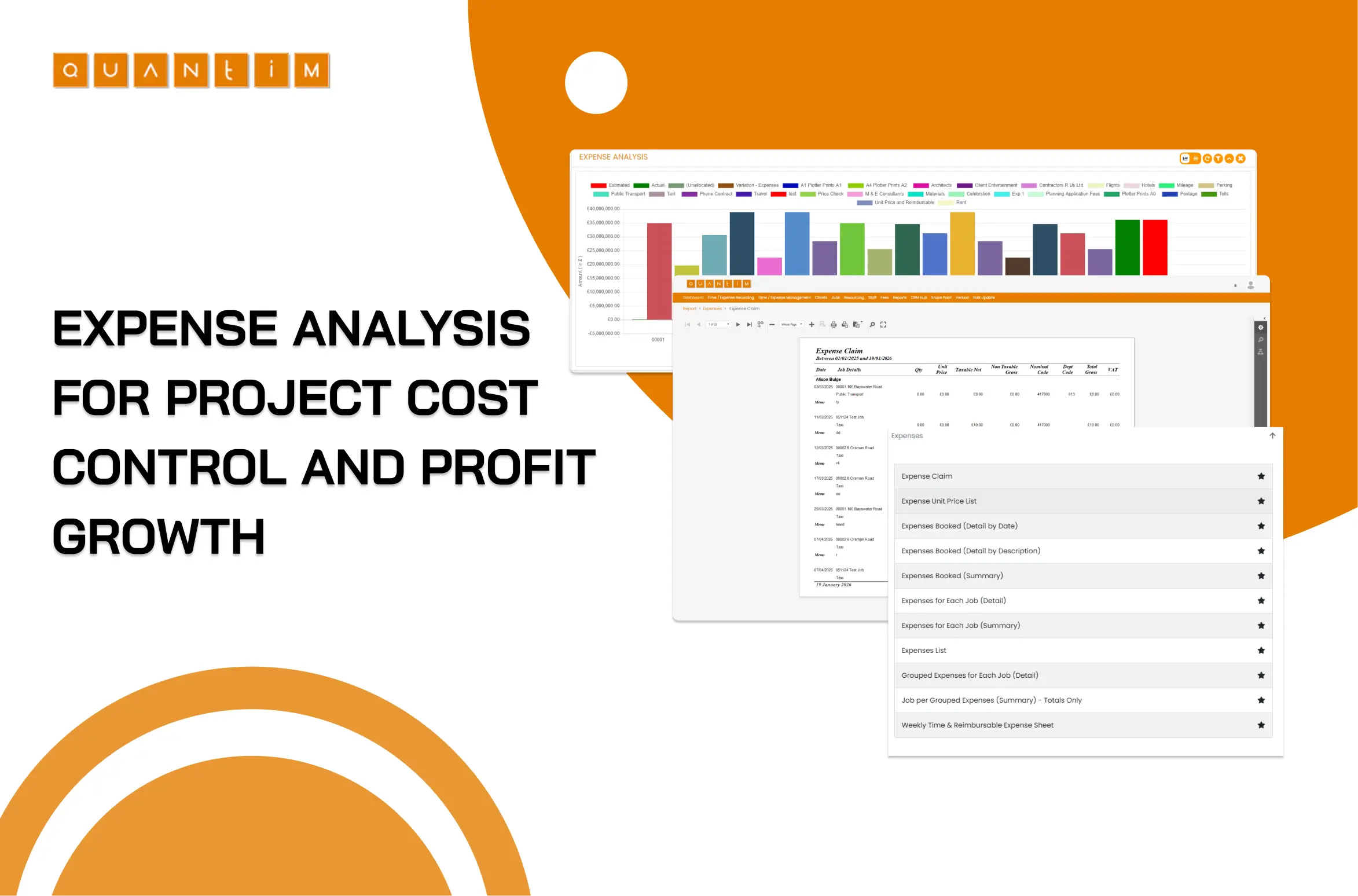
Expenses influence profitability more than most organisations recognise. When costs are submitted late, captured inconsistently or approved without proper checks, businesses lose visibility over their true financial position. The result is inaccurate billing, weak forecasting and preventable leakage that accumulates quietly across every active job until it surfaces as an unexplained margin shortfall at period close.
Many teams still use spreadsheets or informal methods to log expenses. This produces missing receipts, unclear categorisation, unreliable reporting and a persistent gap between what was spent and what was recovered. A structured expense analysis framework closes this gap by ensuring every cost is captured at source, validated against the correct rules and linked to the right job before it has any opportunity to disappear from the financial record.
This article explains why expense analysis matters, where costs most commonly disappear and how Quantim provides a modern, real-time system that strengthens financial accuracy and margin protection across the organisation.
Why Expense Analysis Matters
Clear Visibility of Operational Spend
Without structured expense tracking, operational spend is invisible until it appears in an accounting system days or weeks after the cost was incurred. By that point, the job it relates to may already have been invoiced, the billing window may have closed and the opportunity to recover the cost from the client may have passed entirely. Managers who cannot see where money is being spent in real time cannot intervene before costs escalate, cannot assess whether spending patterns are consistent with project budgets and cannot identify the categories or jobs where cost behaviour is drifting from plan.
Structured expense analysis gives managers an immediate and continuously updated view of where money is being spent, how frequently, by whom and against which jobs. Patterns become visible quickly. Outliers surface before they compound. The organisation shifts from discovering costs after the fact to managing them as they occur.
Protection Against Revenue Leakage
Reimbursable costs are one of the most consistent sources of revenue leakage in professional services organisations. Travel, accommodation, subcontractor charges, specialist equipment, survey costs and other client-attributable expenses represent money the firm has already spent on behalf of a client and is contractually entitled to recover. Yet when these costs are logged informally, submitted late or never attributed to the correct job, they are never included in the invoice. The firm absorbs costs it should have passed on, and the margin of the affected job decreases by exactly the amount of the unrecovered expense.
The breadth of profit leakage that results from this pattern across a portfolio of active jobs is explored in our article on why engineering firms struggle with profit leakage. The finding is consistent: the majority of leakage is not caused by individual large failures but by the repeated, small-scale failure to capture and recover costs that were always recoverable. Accurate expense analysis is the primary mechanism for closing this gap.
Better Planning and Forecasting
Expense data is not only a historical record. It is a forward-looking input that feeds job costing, work in progress calculations, forecasting models and profit reporting. When expense data is incomplete or delayed, every process that depends on it inherits that incompleteness. Forecasts become optimistic because unrecorded costs have not yet reduced the apparent margin. Job cost summaries are understated because expenses incurred last week have not yet been entered. WIP calculations are inaccurate because the full cost basis has not been established.
The daily financial signals that depend on accurate and timely expense data are covered in our article on the three daily financial signals every firm must monitor. Reliable expense capture is the foundation that makes those signals trustworthy rather than misleading.
Stronger Financial Discipline Across the Organisation
A structured expense system does more than improve financial reporting. It changes the behaviour of the people submitting expenses by making the correct process the easy process. When staff are guided through a clear entry flow with required fields, receipt upload prompts and job selection validation, complete and accurate submissions become the default rather than the exception. Financial compliance becomes embedded in the workflow rather than enforced through reminders and retrospective corrections. Accountability is built into the process rather than applied as a management layer on top of it.
Where Expense Costs Actually Disappear
Understanding where costs are lost is as important as understanding why expense analysis matters. The leakage patterns in professional services organisations follow consistent and largely preventable routes. The most common is timing: expenses incurred in one period are submitted in a later period, missing the billing cycle for the job they relate to and either being absorbed as overhead or generating a disputed invoice when they do eventually surface.
The second most common route is misallocation. Expenses are attributed to the wrong job because the correct job code was unclear at the point of entry, because the entry was made in bulk from memory, or because the activity structure did not guide the user clearly enough to the right option. Misallocated expenses corrupt the cost performance of two jobs simultaneously: the one that should have borne the cost shows an artificially strong margin, while the one it was incorrectly attributed to shows an inflated cost figure. Neither picture reflects reality, and decisions made on either are compromised.
The third route is categorisation failure: reimbursable expenses submitted as non-reimbursable, or costs that should be billable flagged as internal. These failures are typically not intentional. They result from unclear rules, insufficient guidance at the point of entry and approval processes that do not consistently catch the error before it reaches the financial record. The allocation rules that prevent these patterns are explored in our article on accurate cost allocation rules and the dos and don'ts every firm should follow.
How Quantim Makes Expense Analysis Easy and Accurate
Quantim provides a complete end-to-end expense workflow that eliminates guesswork, inconsistency and spreadsheet dependence. The platform is designed around the principle that data quality should be built into the entry process rather than corrected after the fact, and that every expense entering the system should immediately and accurately reflect the financial reality of the job it relates to.
1. Expense Entry: Simple, Guided and Consistent
The expense entry screen in Quantim standardises how every staff member records costs. Users select the relevant job, the expense type and supporting details, then upload receipts through a clean, controlled interface that guides them through each required element without requiring financial expertise. Every expense has the required information before it can be submitted. Receipts are stored securely and linked to the entry permanently. Reimbursable items are flagged correctly at source. VAT and accounting rules are applied consistently based on the expense type selected, removing the ambiguity that causes misclassification in informal systems. The goal is complete and accurate submissions without heavy administrative work from the person making the entry.
2. Validation and Business Logic Built Into the Process
Quantim automatically applies organisation-level rules to every expense as it is entered. Whether an expense type is billable to a client, whether VAT should be applied, whether a supporting memo is required, whether the expense can be deleted after submission, and whether it belongs to a specific job or general operations are all determined by rules configured once and applied consistently to every entry from every user. These rules remove the ambiguity that causes financial errors in systems that rely on individual judgement, and they prevent incorrect submissions from reaching the approval stage rather than correcting them after they have already created a data quality problem.
3. Approvals: A Structured Review Process That Maintains Compliance
Once submitted, expenses move into a structured approval workflow where managers and finance teams see a clear, complete list of pending items with receipts, job links, notes and reimbursable indicators all visible in a single view. Approvers can approve, reject or request updates in seconds without needing to chase staff for missing information or open a separate system to verify job details. The approval process ensures that compliance is maintained, that costs are reviewed before they influence financial reports, that incorrect submissions are corrected before they propagate and that access to sensitive financial operations is controlled by role. Nothing reaches the job cost record without having passed through this structured review.
4. Real-Time Impact on Job Costing and Profitability
Once an expense is approved, it updates the financial ecosystem immediately. Quantim reflects the cost across job activity analysis comparing actual against estimate, job cost summaries showing cost against charge, cost vs recovery reporting, fee raising and invoicing readiness, and work in progress and forecasting models. Managers no longer wait until month end to understand project cost performance. Every approved expense immediately improves the accuracy of every financial indicator that depends on knowing the true cost of delivering each job. The connection between real-time expense data and accurate job activity analysis is covered in our article on why job activity analysis matters for every manager.
5. Advanced Reporting for Deeper Financial Insight
Quantim provides multiple expense reports that give organisations genuine insight into spending patterns and financial health rather than simply listing what was spent. Daily and monthly expense summaries, job-level expense breakdowns, grouped expense reports by category or type, reimbursable sheets for client billing and drill-down cost analysis give managers the ability to identify high-cost categories, spot unusual patterns early and build stronger financial planning on the basis of accurate historical data. The profitability metrics that these reports feed into are explored in our article on the profitability metrics every firm must measure, which covers how expense-level visibility connects to margin performance at the job, client and portfolio level.
6. Seamless Integration with Accounting Systems
Quantim connects cleanly with accounting platforms including Sage, ensuring that approved expenses are posted with the correct nominal codes, accurate VAT handling and proper job attribution. Only approved expenses are posted to the accounting system, preventing unreviewed or incorrect entries from entering the financial record. Internal costs can be excluded from client-facing reports. The integration eliminates manual reconciliation between the project management system and the accounting system, removing both the time cost of that reconciliation and the error risk it introduces when performed manually under time pressure at month end.
7. Access Level Control with Proper Financial Boundaries
Quantim controls who can submit expenses, who can approve them, who can edit or delete entries, who can view job-level costs and who can access organisation-wide financial summaries. This access structure ensures that sensitive financial information is protected, that responsibility for each stage of the expense process is clearly defined and that the audit trail for every entry, approval and change is complete and tamper-evident. Financial compliance is maintained not through trust alone but through structural controls that make unauthorised actions impossible rather than merely discouraged.
8. Dashboards: Real-Time Expense Intelligence
Quantim's expense dashboard provides a continuously updated view of total spend, reimbursable against non-reimbursable costs, job-level spending patterns, individual submission behaviour and trends over time. Every dashboard updates instantly as expenses move from submission through approval and into the financial record. Leaders see the current expense position across the organisation without waiting for a report to be compiled, and they can drill into any dimension of that picture to understand the detail behind the summary figure. Real-time cost visibility at this level is what makes proactive cost management possible rather than the reactive version that month-end reporting forces.
Conclusion: Expense Visibility Protects Profitability
Strong expense analysis is not a finance department concern sitting separate from delivery operations. It is a critical operational capability that directly determines how accurately jobs are costed, how reliably they are billed and how effectively the organisation protects its margins across every active project. Organisations that track expenses accurately gain better control of margins, clearer insight into job performance and significantly reduced financial risk from the leakage that informal systems allow to accumulate.
Quantim gives businesses a structured, real-time expense system that removes guesswork, eliminates leakage and connects every cost to the broader financial picture the organisation depends on. With guided entry, controlled approvals, advanced reporting, live dashboards and seamless accounting integration, Quantim turns expense management from an administrative obligation into a genuine source of financial intelligence. For organisations seeking to connect expense management with the full project financial lifecycle, our article on end-to-end tracking software for modern organisations covers how expense data integrates with time, WIP, forecasting and billing in a single connected system.
If you want to transform how your organisation handles expenses and protect the profitability it has earned, contact us at info@quantim.co.uk or book a demonstration below.