
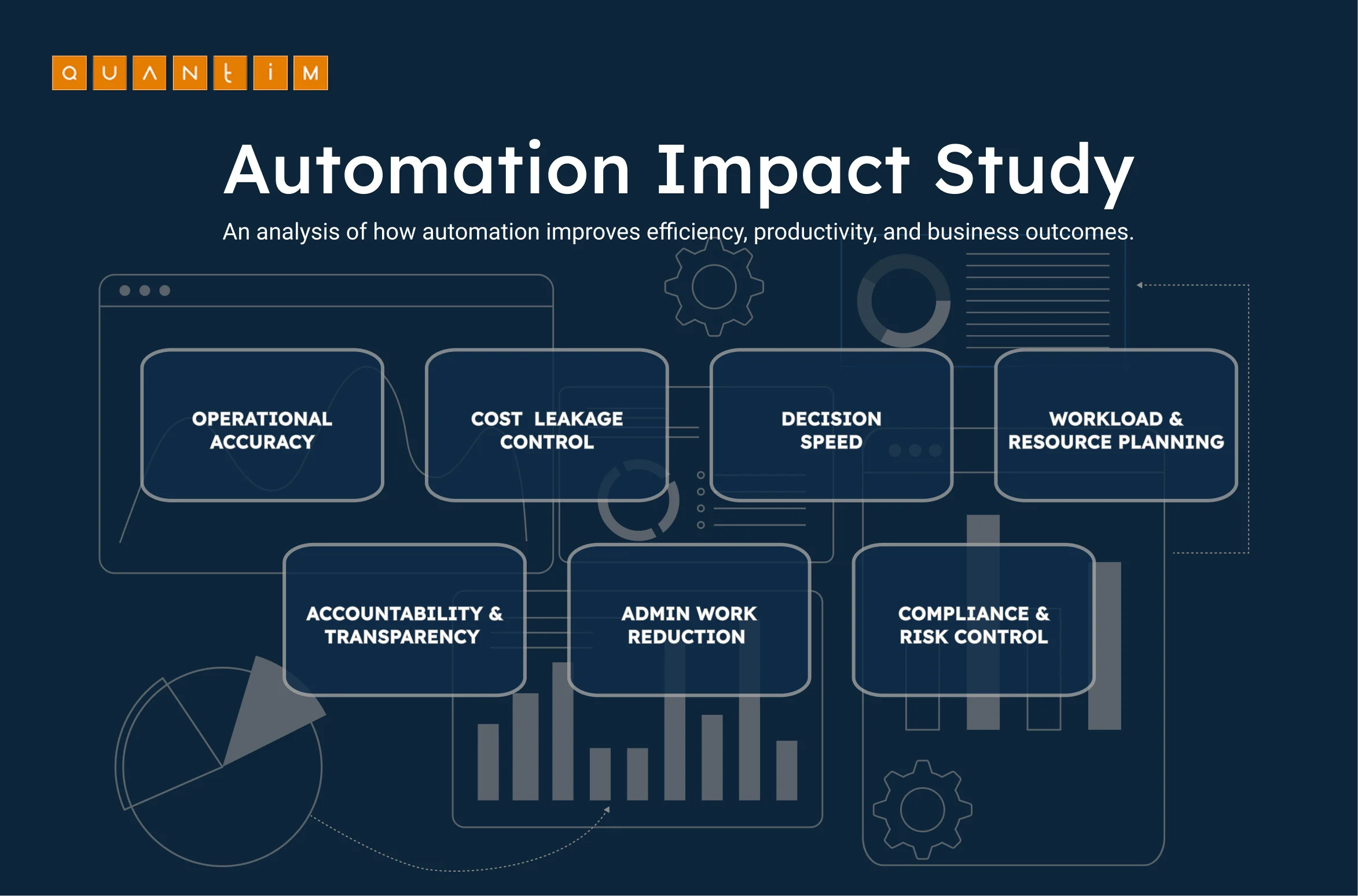
Automation has become one of the most influential drivers of operational efficiency in modern organisations. As companies face increasing pressure to deliver faster, reduce cost, minimise risk and operate with greater precision, manual processes can no longer keep pace with the complexity of the environments they are supposed to support. The gap between what manual processes can reliably maintain and what project-based organisations actually need to know to make good decisions is where performance problems originate.
This automation impact study explores how organisations benefit when key workflows are automated across engineering, EPC, architecture, consulting, education, technology and professional services. Instead of relying on spreadsheets, emails and informal communication, structured automation introduces consistency, accountability and real-time visibility that strengthens performance across every department. The findings reflect operational patterns observed across multiple industries and organisation sizes, from growing professional practices to multi-site engineering firms.
1. Automation Improves Accuracy Across Operational Workflows
Manual processes are structurally vulnerable to human error. Not because the people executing them are careless, but because manual processes depend on individual memory, individual interpretation and individual consistency across dozens of daily data entry decisions. Delayed updates create records that are accurate as of last week rather than today. Forgotten tasks leave gaps in the operational picture that only become visible when they cause a downstream problem. Inconsistent reporting formats make cross-team comparison unreliable. Missing documentation creates disputes that could have been prevented by a single structured entry at the time the relevant event occurred.
When organisations automate their core operational workflows, the accuracy of their data improves not because people become more careful but because the system makes the correct behaviour structurally easier than the incorrect one. Time recording reminders arrive before entries are forgotten rather than after. Progress updates are captured in a structured format that prevents the ambiguity of free-text notes. Audit trails are maintained automatically rather than reconstructed from memory. The improvement in data quality that follows from this structural change directly improves the quality of every decision that depends on that data. The specific data blind spots that automation eliminates in engineering environments are examined in our article on eliminating data blind spots in engineering.
2. Automation Reduces Cost Leakage and Financial Drift
Cost leakage is one of the largest and least visible operational problems in project-based organisations. When activities, changes and delays are tracked manually, the financial picture that results is consistently incomplete. Unrecorded labour hours are not billed. Undocumented variations are not priced. Rework that has not been attributed to its cause cannot be recovered from the party responsible for it. Overspend that is not detected until month end cannot be corrected in the period it occurs, forcing the organisation to manage consequences rather than causes.
Automation addresses cost leakage by ensuring that cost-related information is captured consistently at the point it is generated rather than reconstructed later. When every activity update, labour entry and variation is recorded in a structured system that connects to job costing in real time, the gap between actual cost and reported cost narrows to near zero. Organisations that make this transition typically see measurable improvement within the first few months because the earlier detection of drift allows intervention before the cost compounds. The documented commercial impact of systematic cost leakage reduction in engineering organisations is examined in our article on how EPC firms reduce cost leakage by 15 percent.
3. Automation Speeds Up Decision Making
Operational decisions slow down when leaders must wait for updates, collect information from multiple sources, reconcile conflicting data or interpret reports that were accurate when compiled but have since been superseded by events. This delay is not a management capability problem. It is a data infrastructure problem. When the information required to make a decision is unavailable, inaccurate or distributed across systems that do not communicate with each other, the rational response is to wait for better information or to make the decision with lower confidence than it deserves.
Automation removes this bottleneck by ensuring that the data supporting every operational decision is current, integrated and accessible without manual preparation. Approval cycles compress because the information needed to approve has already been validated. Reporting timelines shorten because reports draw from live data rather than requiring manual compilation. Risks surface immediately rather than at the next scheduled review. The transition from decision making based on assembled information to decision making based on live operational intelligence is the subject of our article on moving from guesswork to clarity, which covers how the data infrastructure behind decisions determines the quality and confidence of those decisions more reliably than the judgement of the people making them.
4. Automation Strengthens Workload and Resource Planning
Resource utilisation is fundamentally difficult to manage when activity updates and time entries are inconsistent. If the time data entering the system is a partial or delayed record of what actually happened, the utilisation picture it produces is a partial and delayed picture of where capacity actually is. Decisions made on this picture, whether about allocating new work, identifying overload or planning hiring, are made on inaccurate inputs and produce outcomes that do not match expectations.
When time recording is automated and consistent, the utilisation picture becomes reliable enough to manage from. Workload imbalances are visible before they become delivery problems or wellbeing issues. Bottlenecks during critical project phases can be anticipated and addressed rather than discovered when they begin affecting delivery. Evidence-based planning replaces assumption-based planning for every resourcing decision from daily task allocation to quarterly capacity forecasting. The specific consequences of poor workload distribution for team wellbeing and long-term performance, particularly in design and technical environments, are explored in our article on burnout in design teams and how better resource planning prevents it.
5. Automation Enhances Accountability and Transparency
When processes are automated, responsibilities become structurally clearer. Every update, decision or change is recorded with a timestamp and an owner. There is no ambiguity about whether a task was completed, when it was completed or who completed it. The history of a project, a variation or a client communication is always available without requiring anyone to reconstruct it from memory or email archives. This is not surveillance. It is the operational condition that makes fair and accurate accountability possible.
The cultural effect of this transparency is significant and often underestimated. When team members know that their contributions are accurately recorded and visible, the motivation to complete tasks correctly and on time shifts from compliance to ownership. When managers can see the operational record without assembling it manually, they spend their time on the decisions and relationships that require judgement rather than on information gathering that should be automatic. The connection between transparent project tools and a genuine culture of accountability is explored in our article on building a culture of accountability with transparent project tools.
6. Automation Frees Teams from Manual Administration
Administrative work consumes a disproportionate share of productive time in most project-based organisations. Updating spreadsheets, chasing timesheet submissions, compiling reports from multiple sources, reconciling data between systems and preparing documentation that a structured platform would generate automatically: all of these tasks represent hours that are spent maintaining the operational record rather than advancing the work it records. The opportunity cost is direct and measurable.
When repetitive administrative tasks are automated, the time recovered is available for the work that generates client value, advances project delivery and builds the professional capabilities that determine long-term competitive performance. The reduction in administrative workload also reduces the cognitive load that manual process maintenance places on managers and operational staff, improving the quality of the higher-order work they can redirect their attention to. Organisations that automate their operational administration consistently report improvements in both productivity metrics and team satisfaction, because the work that remains after automation is the work that professionals chose their careers to do.
7. Automation Improves Compliance and Reduces Operational Risk
Compliance gaps in project-based organisations most commonly arise not from deliberate non-compliance but from inconsistencies in how tasks are recorded, monitored and documented. When processes are manual, the completeness and accuracy of the compliance record depends on individual attention and individual habit rather than structural enforcement. Under time pressure, which is the normal condition in project delivery, compliance documentation is the first thing that is deprioritised, creating audit exposures that may not surface until a dispute or an inspection makes them consequential.
Automation closes these gaps by making compliance documentation a natural output of normal operational activity rather than a separate administrative obligation. Every time entry, progress update, variation and approval creates a structured, timestamped and tamper-evident record as a by-product of the operational process it records. The compliance history exists automatically, without anyone having to maintain it separately. This makes organisations demonstrably more resilient in audits, disputes and client reviews, and it reduces the management overhead associated with ensuring that compliance requirements are being met consistently across a growing team.
Measuring Automation Maturity
Not all automation delivers equal value, and the distance between having digital tools and having genuine operational automation is wider than most organisations realise. The most useful framework for assessing automation maturity asks not whether a process is digital but whether it is consistently accurate, whether it updates in real time, whether it connects to the processes that depend on it and whether it reduces rather than creates manual work at the boundaries between systems.
Organisations at the lowest maturity level have replaced paper with spreadsheets. The format is digital but the process is still entirely manual, with all the accuracy and consistency problems that manual processes produce. The next level introduces dedicated tools for specific functions, time tracking or expense management or project planning, but these tools operate in isolation and require manual data transfer between them. Genuine automation maturity is reached when these tools are connected in a live operational model where data flows automatically from entry to reporting without human bridging work at any stage.
The return on investment from reaching this level of integration, and the commercial gap between organisations that have and those that have not, is examined in our article on the true ROI of smarter project tracking. Understanding where your organisation sits on this maturity curve is the starting point for identifying where automation investment will produce the most significant operational and financial improvement.
What Automation Does Not Fix
Automation strengthens processes that are structurally sound. It cannot rescue processes that are fundamentally poorly designed, and it cannot replace the leadership judgement that determines which work should be done, how client relationships should be managed and how to respond to the genuinely novel situations that project delivery consistently produces. An automated process that captures the wrong data consistently is more efficiently wrong than a manual process that captures the wrong data inconsistently, but it is not better. The discipline of ensuring that what is being automated is worth automating is a leadership responsibility that technology cannot assume.
The most successful automation implementations are those where the operational discipline they support has already been established in principle, even if it has been difficult to maintain consistently in practice. Automation makes consistent execution structurally achievable. It does not create the commitment to consistent execution where that commitment does not already exist at the leadership level.
Conclusion
Automation reshapes how organisations operate across every dimension of project delivery, financial management and team performance. It strengthens accuracy by making correct behaviour structurally easier than incorrect behaviour. It reduces cost leakage by capturing financial data at the point it is generated rather than reconstructing it periodically. It accelerates decision making by ensuring that current, integrated data is always available without manual preparation. It improves resource planning, accountability, compliance and administrative efficiency simultaneously, because all of these outcomes draw from the same underlying improvement: operational data that is accurate, current and connected.
Quantim plays a central role in this transition by unifying time, cost, progress, variations and work in progress into one automated platform that reduces risk, improves financial performance and allows teams to operate with confidence rather than uncertainty. The broader shift toward unified operational tools as the new standard for project-based industries is examined in our article on why every industry needs unified project tools. If your organisation is exploring the impact of automation on cost control and operational visibility, contact us at info@quantim.co.uk or book a demonstration below.