
Forecasting is one of the most critical financial disciplines for any organisation that manages projects. Yet many teams still struggle with unclear projections, inconsistent billing schedules, fragmented information and manual spreadsheets that quickly fall out of date. When forecasting breaks down, financial planning becomes reactive rather than strategic, leading to delayed billing, inaccurate cash flow predictions and avoidable revenue loss that compounds quietly across every active project.
Quantim's forecasting system solves this problem by giving organisations a structured, real-time and transparent way to plan, track and manage all future fee expectations. It replaces guesswork with accuracy and transforms forecasting from an administrative exercise into a controlled financial discipline that leaders can rely on. The practical techniques that underpin reliable project forecasting are explored in our article on time forecasting hacks for better project planning, which covers the habits that keep projections accurate as project conditions evolve.
Why Forecasting Matters
Forecasting directly influences revenue planning, cash flow stability, invoicing cycles, client communication, resource allocation and project profitability simultaneously. These are not independent concerns that can be managed separately: a forecasting failure in one area produces downstream consequences in all the others. An inaccurate fee forecast leads to a billing schedule that does not reflect actual delivery, which produces a cash flow position that does not match the business plan, which affects resource decisions that were budgeted against revenue that has not yet been secured.
Without a reliable forecasting method, organisations face uncertainty that compounds over time. Billing becomes reactive, triggered by client requests or period-end pressure rather than by a disciplined schedule aligned to project milestones. Revenue recognition becomes unreliable because the work in progress position cannot be accurately calculated without knowing what fees are planned and when. Client communication around fees becomes defensive rather than transparent. Quantim eliminates this uncertainty by providing a unified forecasting workflow that connects directly to job activities, variations and fee structures, keeping every projection grounded in operational reality rather than financial aspiration.
The Forecasting Problems This System Solves
Most forecasting failures in project-based organisations share the same root causes. Projections are built in spreadsheets that are not connected to the time tracking, expense or WIP systems that reflect current project performance. Forecasts are updated manually when someone remembers to update them, which means they drift progressively further from reality as projects evolve. Different team members maintain different versions, producing the same version-conflict problems that affect every other spreadsheet-based operational process.
The consequence is a forecasting function that tells leaders what was expected at the start of a period rather than what is likely to happen based on current conditions. Billing milestones are missed because nobody flagged that a forecast date had passed without a fee being raised. Revenue is deferred because the fee-raising process depends on someone manually reviewing the forecast schedule and taking action on each item. Cash flow surprises arrive at month end because the forecast was not updated to reflect a variation that was agreed three weeks earlier.
These are not marginal inefficiencies. They represent material and recoverable revenue that organisations consistently fail to capture because their forecasting infrastructure is not designed for the operational reality of project delivery. The forecasting metrics that sit at the centre of project profitability are covered in our article on the profitability metrics every firm must measure, which explains how forecast accuracy connects directly to fee recovery, WIP accuracy and overall margin performance.
How Quantim Strengthens Forecasting
Quantim's forecasting system is designed to be simple for users while powerful enough for financial leaders who require clarity across all projects. Instead of manually calculating future fees or relying on disconnected reports, teams use a structured workflow that keeps every projection accurate, attributable and current.
1. Forecasts Directly Linked to Activities and Variations
Quantim allows users to build forecasts that are aligned with specific activities or variations within a job rather than attached to the job as a single undifferentiated amount. This activity-level connection means that forecasts are not generic estimates built in isolation from the work they represent. Each projection is tied to a clear work component that someone on the delivery team can identify and verify, which prevents the ambiguity that leads to billing disputes and missed fee raises. When a variation is agreed, the forecast for that variation is created in the same system that tracks the time and cost associated with delivering it, keeping the financial picture and the operational picture permanently aligned.
2. A Unified View of All Forecasted Fees
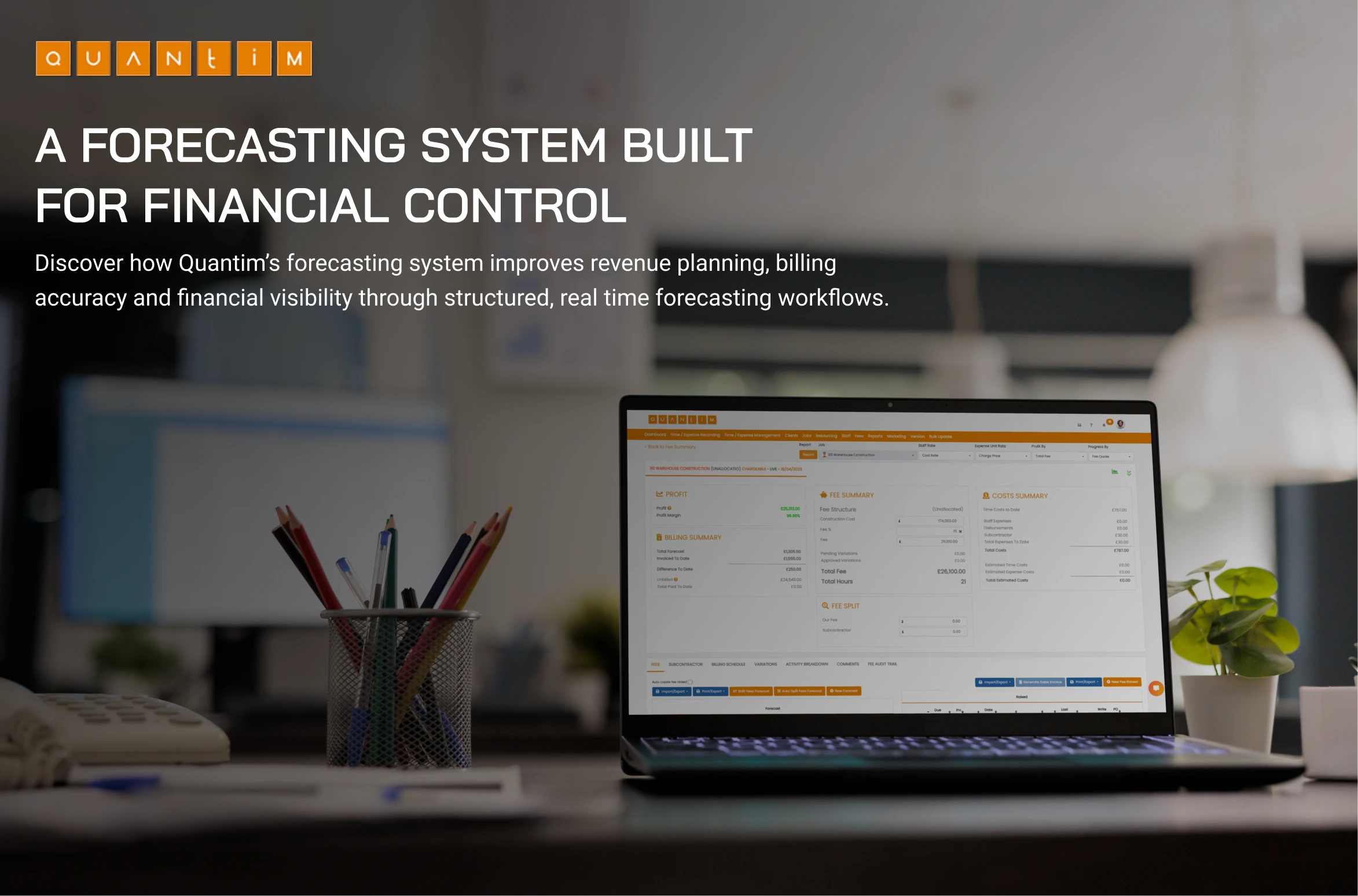
Quantim displays all upcoming forecasts in a structured view that gives leaders a single source of truth for all projected revenue. The view shows what fees are planned, when they should be raised, what portion has already been billed, what remains outstanding and cumulative totals for financial tracking across the entire job. This unified picture eliminates the need to cross-reference multiple spreadsheets or chase project managers for billing status updates. Finance teams can see the complete fee pipeline for every active job at a glance, updated continuously as work progresses and fees are raised, without any manual compilation.
3. Optional Automation for Fee Raising
One of the most operationally significant capabilities is the ability to automate fee raising based on approved forecasts. When enabled, Quantim generates fee entries automatically in line with the forecast schedule, removing the dependency on billing teams manually monitoring forecast dates and taking action on each item. Revenue cycles become more consistent and timely because the system enforces the billing discipline that manual processes rely on individuals to maintain. The administrative overhead of manual billing management, and the revenue loss that results from billing delays, is the same problem explored in our article on replacing manual processes to recover lost revenue. Automation does not remove the need for human review, but it removes the need for human initiation of every billing cycle event.
4. Granular Fee Breakdown for Complex Jobs
Some forecasts require detailed breakdowns because the projected amount spans multiple deliverables, disciplines or billing components that need to be tracked and invoiced separately. Quantim supports this by enabling users to split forecast values into smaller parts, add descriptions for each component and track partial billing against each segment individually. This level of granularity ensures that no portion of the forecast becomes ambiguous, overlooked or incorrectly consolidated into a single invoice line when the underlying work has multiple distinct components. For organisations delivering complex multi-discipline projects, this capability is essential for maintaining billing clarity across the full scope of the engagement.
5. Full Control Over Partial and Multi-Stage Billing
Not all fees are raised at once. Milestone billing, stage payments and progressive invoicing are standard in engineering, architecture, consulting and construction, and forecasting systems that do not accommodate them accurately cannot support the billing discipline these industries require. Quantim allows teams to raise a portion of a forecasted fee, raise multiple fees against the same forecast over time and track remaining values continuously so that nothing is accidentally billed twice or inadvertently left unbilled. The connection between multi-stage billing control and invoice accuracy is covered in our article on the seven essential invoice accuracy checks, which shows how the discipline of phased billing management directly determines the quality of what reaches the client.
6. Real-Time Tracking of Billed and Paid Amounts
Quantim maintains a live record of the total amount billed against each forecast, payments received, the remaining amount yet to be billed and cumulative totals across the job. This real-time transparency means that the gap between forecasted revenue and actual billing is always visible and always current, not discovered at period close when the opportunity to address it has largely passed. The connection between live billing tracking and accurate budget planning is explored in our article on turning operational data into better budgets. When revenue tracking updates in real time alongside cost and expense data, cash flow planning becomes a live operational discipline rather than a monthly reconstruction exercise.
Why Organisations Prefer Quantim for Forecasting
The forecasting system in Quantim delivers competitive advantage across five dimensions that individually improve financial performance and collectively transform it. Consistency is the first: all forecasts follow a unified structure, which eliminates the version conflicts, formula errors and categorisation inconsistencies that make spreadsheet-based forecasting progressively less reliable as the portfolio grows. Accountability is the second: every projection is clearly linked to an activity, variation or deliverable, which means there is always a named owner and a defined scope for each fee expected.
Predictability follows from consistency and accountability: when forecasts are structured, current and grounded in operational reality, leaders can anticipate revenue accurately across the full financial year rather than managing a series of monthly surprises. Control is the fourth dimension: billing teams have full visibility into what needs to be raised and when, supported by optional automation that removes the manual dependency from the most time-sensitive parts of the billing cycle. Efficiency is the outcome of all four: when forecasting is accurate, accountable and largely automated, the administrative workload of financial management decreases significantly while the quality and timeliness of the outputs improve. The two reporting outputs that complete the financial picture this forecasting discipline creates are covered in our article on the two reports every manager needs for smarter billing.
How Quantim Transforms Financial Visibility
When forecasting is connected to activities, fees, variations and billing history in a single live system, organisations gain an end-to-end view of project finances that is structurally impossible to achieve through spreadsheets or disconnected tools. Missed billing becomes visible before the billing window closes rather than after. Revenue recovery improves because the gap between earned and billed value is always surfaced. Forecasting accuracy increases because projections are built on current operational data rather than historical assumptions. Client communication around fees becomes more transparent because the billing schedule is structured and documented rather than informal and reactive.
Cash flow predictability improves because the fee pipeline is accurate, current and integrated with the cost and expense data that sits alongside it. Variation management becomes more professional because variations are captured in the same system as the original forecast, preventing the disconnection that allows authorised additional work to go unbilled. Quantim gives organisations the financial backbone that structured project delivery requires, replacing the reactive billing culture that spreadsheet dependency produces with a proactive revenue management discipline that compound its value over every billing cycle.
Conclusion
Forecasting is not simply a financial task. It is a strategic practice that determines whether organisations operate with revenue clarity or revenue uncertainty, and whether billing disciplines are enforced by structure or dependent on individual memory and initiative. Quantim's forecasting system provides a reliable foundation for revenue planning, billing accuracy and financial performance by linking every projection to real work, enabling automation where it reduces risk and presenting a unified view of future fees that every stakeholder can work from simultaneously.
The missed billing that poor forecasting allows to accumulate is examined in our article on how to prevent billable hours and fees from slipping away. By moving from reactive billing to proactive financial control, organisations recover revenue they have already earned and build the cash flow predictability that confident business planning requires.
To explore how Quantim can support your forecasting and financial control strategy, contact us at info@quantim.co.uk or book a demonstration below.