
Cost leakage is one of the most significant operational and financial challenges in the EPC (Engineering, Procurement and Construction) sector. It does not appear as a single event but arises from hundreds of daily decisions, undocumented updates and disconnected workflows. Studies across the industry show that leakage commonly reaches 10 to 25 percent of total project cost when organisations rely on fragmented systems and manual processes.
Many EPC firms experience the same recurring issues across multiple projects. Budgets and schedules might be well structured at the outset, yet maintaining real control over actual cost performance becomes increasingly difficult once execution begins. Delayed reporting, inconsistent field updates, manual spreadsheets and disjointed communication create blind spots that make financial drift almost impossible to detect early.
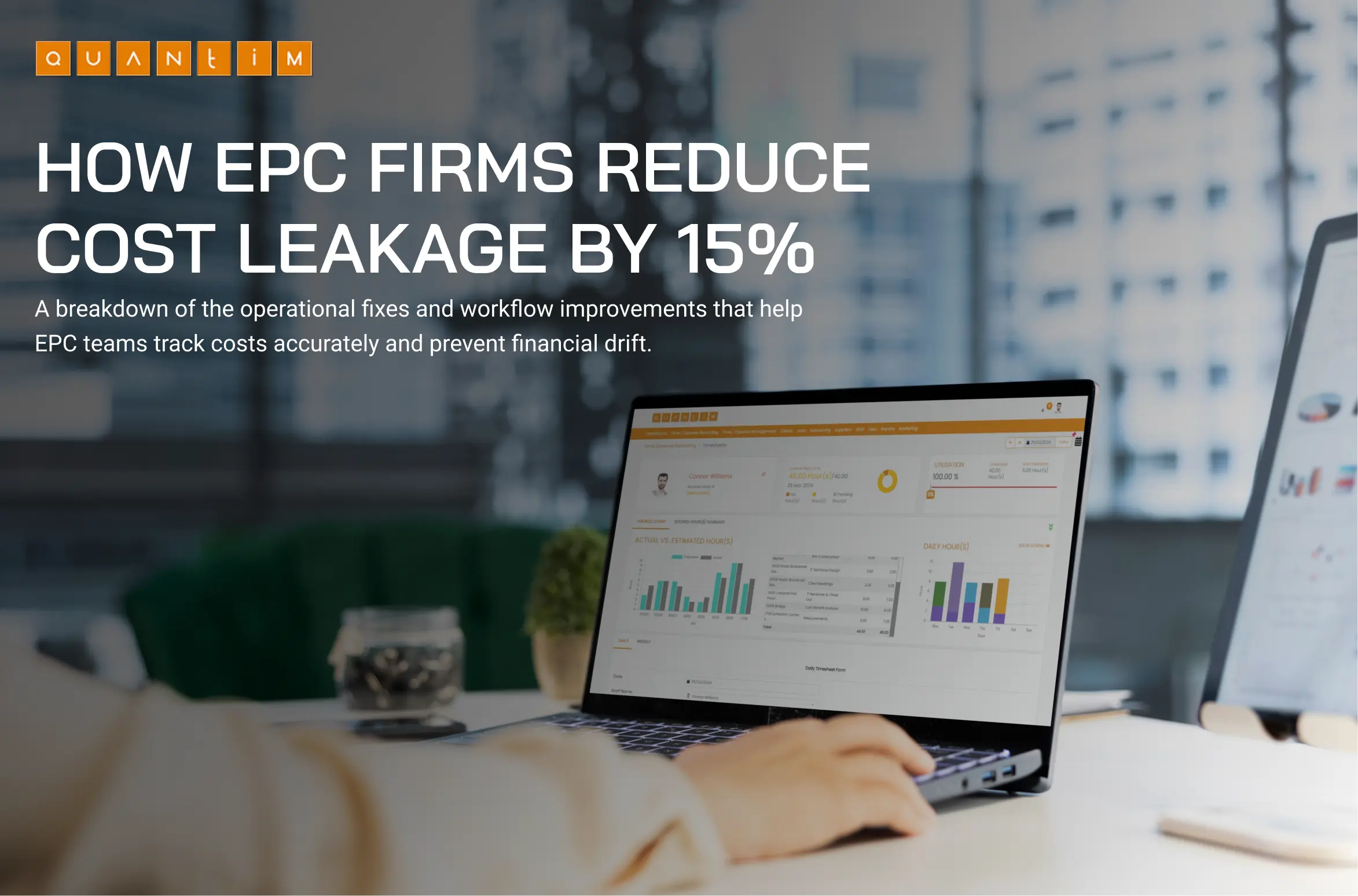
To address this, EPC firms have begun adopting structured cost control frameworks supported by digital systems such as Quantim. Many have reported measurable reductions in cost leakage, often achieving improvements of up to 15 percent within their first year. These gains occur because visibility, workflow discipline and operational alignment are strengthened at every stage of the project lifecycle.
Below is an in depth breakdown of the operational areas where leakage typically occurs and how EPC organisations are overcoming these challenges.
1. Standardising Operational and Financial Data Capture
One of the strongest root causes of leakage is inconsistency in how teams record information. EPC projects involve designers, engineers, procurement teams, planners, subcontractors, supervisors and commercial managers. When each group captures data differently, financial clarity disappears.
Common issues include:
- Time sheets recorded late or with vague descriptions
- Field updates sent via chat apps with no structured format
- Procurement records stored across multiple spreadsheets
- Variations handled informally
- Rework never logged
- Progress measured inconsistently across departments
This lack of uniformity results in fragmented cost data that cannot be analysed accurately.
How EPC organisations fix this
They implement structured and standardised data capture processes that define:
- Daily time recording rules
- Clear activity and cost code categories
- Standard templates for progress reporting
- Documented variation logs
- Defined workflows for approvals
- Consistent procurement record keeping
How Quantim strengthens this
Quantim provides predefined structures for time entry, progress updates, variations, rework, procurement and WIP. This ensures all data across the organisation follows the same format, producing clean, comparable and financially reliable information.
2. Establishing Real Time Visibility Instead of Retrospective Discovery
Most EPC organisations historically detect leakage too late because cost reviews occur weekly or monthly. By the time overspend appears in a report, weeks of financial drift have already occurred.
Real time visibility transforms cost control by enabling teams to:
- Spot cost overruns on the day they begin
- Compare actual hours versus budget instantly
- View live progress at job and activity level
- Measure daily productivity
- Identify delays before they escalate
- Receive alerts when thresholds are exceeded
Why real time visibility matters
Projects move fast. A delay in cost information creates delayed corrective action. Real time insight reduces risk across scheduling, labour allocation, procurement and quality.
How Quantim enables real time visibility
Quantim synchronises field updates, labour records, cost data, variations and progress into a single dashboard that leadership can view at any moment. This allows organisations to act proactively, not reactively.
3. Introducing Structured Change and Variation Management
Scope drift is one of the largest contributors to leakage in EPC projects. Changes happen frequently in design, installation, procurement and execution, yet many organisations fail to document these adjustments properly.
Symptoms include:
- Changes completed without approval
- Additional work absorbed into existing budget
- Client requests not tracked
- Time spent on modifications not recorded
- Impacts on timelines not communicated
This leads to unrecovered costs and commercial disputes.
How EPC organisations fix this
They implement structured change control processes that:
- Capture every change request
- Document impact on time, cost and scope
- Require approvals before work continues
- Link changes directly to relevant cost codes and work packages
How Quantim supports this
Quantim provides a complete variation management workflow. Every change is logged, costed, timestamped and connected to the corresponding project activity, ensuring full transparency and traceability.
4. Making Rework Visible Instead of Hidden
Rework is unavoidable, but unmanaged rework is one of the largest hidden sources of cost leakage. Many EPC teams correct errors quickly in order to keep work moving, but the time spent is rarely recorded.
Common causes include:
- Drawing inconsistencies
- Design misalignment
- Incorrect installation
- Late information release
- Material issues
- Miscommunication between teams
Without tracking rework, organisations lose visibility into how much time and budget is consumed by avoidable inefficiencies.
How EPC organisations fix this
They classify rework as a measurable cost item and require:
- Logging rework hours
- Categorising the cause
- Linking rework to responsible activity
- Reviewing patterns to eliminate root causes
How Quantim enhances rework visibility
Quantim provides a tracking module that captures time, cost and root causes so organisations can prevent repeat mistakes and strengthen operational discipline.
5. Unifying All Operational Data into One Platform
Fragmentation is one of the main causes of leakage. EPC companies often manage projects using a mix of:
- Spreadsheets
- ERP modules
- Email threads
- Messaging apps
- Field notebooks
- Legacy systems
This creates operational blind spots because information is scattered, duplicated or lost.
How EPC organisations fix this
They unify project, field and financial data into a single system where every update can be captured, verified and traced.
How Quantim solves data fragmentation
Quantim becomes the operational backbone for EPC organisations by integrating:
- Time and labour tracking
- Job and activity level progress
- Procurement and cost control
- Field reporting with evidence
- Variations and approvals
- WIP calculation
- Forecasting and dashboards
This allows teams to operate from one accurate source of truth.
Why Many EPC Firms Achieve 15 Percent Leakage Reduction with Quantim
Quantim enables EPC companies to fix the exact operational gaps that cause leakage, including:
- Inconsistent time entry
- Untracked variations
- Undocumented rework
- Poor progress measurement
- Manual WIP
- Fragmented communication
- Inaccurate forecasting
By replacing guesswork with live, structured, verified data, organisations gain financial discipline and cost accuracy across every project.
Conclusion
Cost leakage in EPC delivery grows quietly when organisations rely on fragmented tools and inconsistent processes. By standardising data capture, achieving real time visibility and introducing automated cost control workflows, EPC companies can significantly reduce leakage and improve overall project profitability.
With Quantim supporting this transformation, organisations build a predictable, transparent and financially resilient operational environment.
For more information or support, contact us at info@quantim.co.uk.