
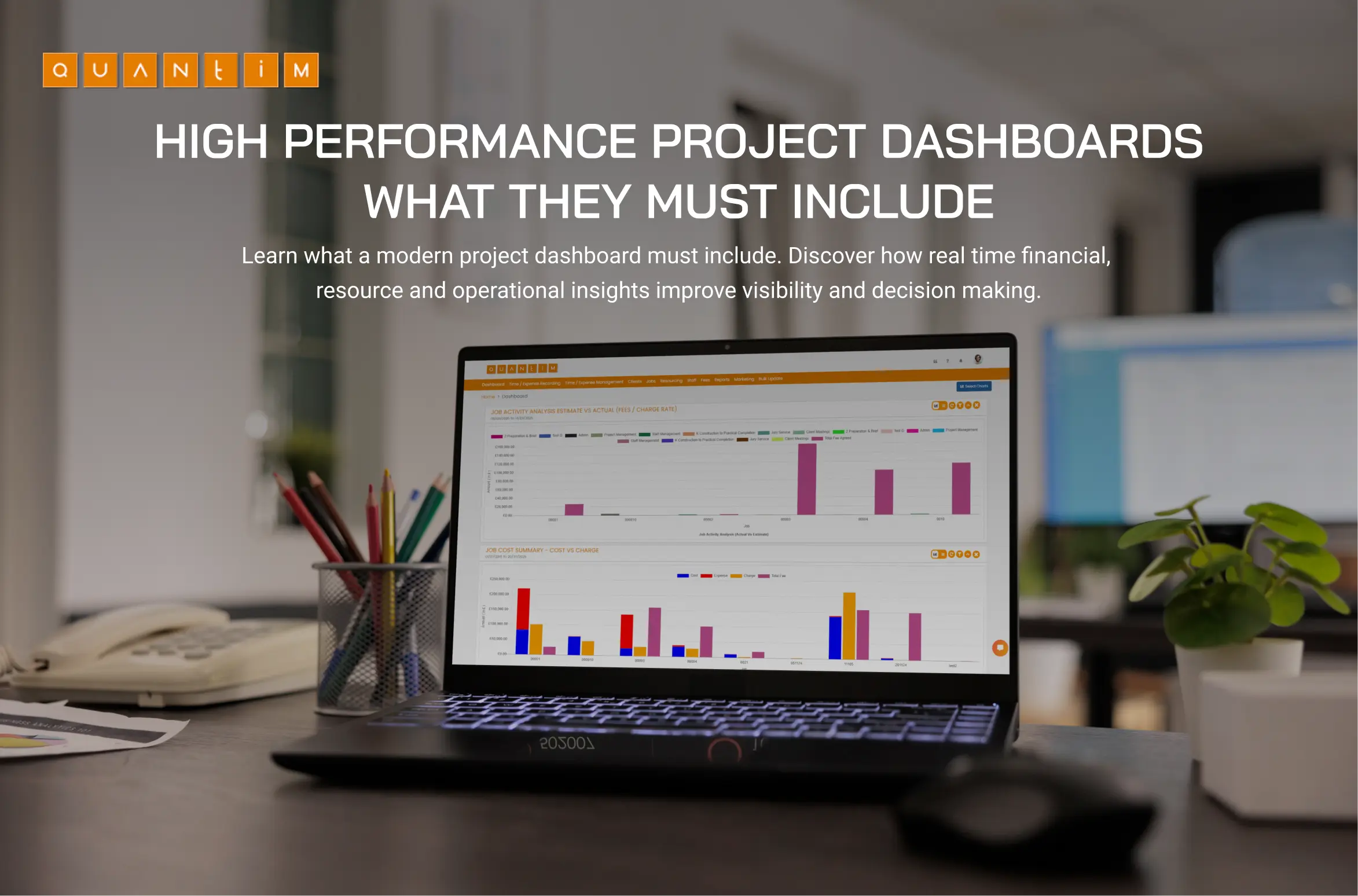
A dashboard is the decision centre of every modern organisation. It is the place where performance becomes visible, where risks surface early and where managers understand the real state of projects, resources, revenue and workload. Yet many firms still operate with outdated or shallow dashboards that look attractive but fail to deliver meaningful insight.
A well designed dashboard is not only a visual layer. It is a strategic tool that connects data from time tracking, expenses, resources, fees, forecasting, staffing and project progress into one understandable space. When used correctly, it helps senior leaders, project managers, operational teams and finance teams make faster and more confident decisions.
This blog explores what a high performance dashboard should contain, why it matters and the type of results organisations gain when they use dashboards that provide real time operational truth. At the end, we introduce how Quantim delivers this level of visibility through a configurable and deeply structured dashboard system.
1. Why Dashboards Matter More Than Ever
The shift towards real time work has created new expectations in project based firms. Leaders can no longer wait for weekly reports, manual spreadsheets or monthly reviews to understand performance. Instead, they need instant visibility into:
- How staff are spending their time
- Which projects are drifting off plan
- Where costs are rising
- Which clients are becoming risk points
- How invoices and payments behave
- What resources are under or over utilised
- Which approvals are blocking progress
A modern dashboard gives immediate clarity on these questions. It removes dependency on manual reporting, reduces the time spent consolidating data and gives teams a shared version of the truth. Most importantly, it helps teams intervene before a financial or delivery issue becomes serious.
2. What a Modern Dashboard Should Include
A dashboard must serve different types of users. It must provide value to CEOs, project managers, resource planners, finance teams and operational leaders. To deliver this breadth of value, it must include the following categories of insight.
A. Financial and Fee Visibility
A dashboard must show clear financial indicators without requiring a separate report. Effective financial visibility includes:
- Total forecast
- Total billed
- Total paid
- Total profit
- Monthly invoiced versus planned versus target
- Fees by job type, status, sector and project sector
- Remaining fees to invoice
- Fees raised and paid per client
- Revenue concentration by client
These views support strategic decisions and help leadership understand performance trends and exposure.
B. Resource and Staffing Intelligence
People drive both cost and delivery. A strong dashboard provides clarity into staff performance:
- Staff hours updated in real time
- Daily, weekly, monthly and yearly staff utilisation
- Weekly staff projection
- Staff availability
- Staff retention indicators
- Non job hours analysis
With this insight, managers can anticipate workload pressure, rebalance teams and prevent burnout or under utilisation.
C. Delivery and Project Performance
The dashboard should highlight how projects behave operationally. Important indicators include:
- Actual versus estimated hours
- Actual versus estimated fees
- Job cost summary
- Activity performance by job
- Subcontractor split profit
- Cost versus recovery
- WIP position
- Task progress and team to do lists
- Open tickets and ticket behaviour
These insights protect margins and prevent delays caused by hidden task drift or uncontrolled time usage.
D. Forecasting and Planning Visibility
Leaders must be able to see what is coming next, not only what has already happened. Modern dashboards incorporate:
- Monthly, quarterly and yearly order view
- Growth comparison between years
- Forecasted fees raised and paid
- Remaining fees to invoice against forecast
- Expected versus target performance
Forecasting helps organisations plan hiring, resource distribution, pricing decisions and cash flow management.
E. Approvals, Compliance and Operational Flow
Slow approvals create blockages that affect invoicing, payroll, cash flow and project delivery. Dashboards must highlight:
- Pending timesheet approvals
- Pending expense approvals
- Pending holiday approvals
- Expense behaviour
- Holiday performance
A dashboard should help leaders understand where operational friction exists and how to remove it.
F. Client and Performance Intelligence
Client behaviour affects revenue stability, cash flow and long term growth. Dashboards should show:
- Top clients by order value
- Top clients by payment due
- Top clients by revenue
- Client CLV
- Client CRR
- Ticket CES
- Feedback through CSAT
These insights help firms make better decisions on pricing, service structure, communication and client management.
3. Who Benefits from a Strong Dashboard
- CEOs: Gain instant clarity on revenue, utilisation, profitability and early warnings.
- Project Managers: Understand project drift, variances, workload, job performance and resource behaviour.
- Finance Teams: Monitor invoicing, WIP, expenses, approvals and payment performance in real time.
- Resource Planners: See capacity, availability, utilisation and upcoming demand with accuracy.
- Operational Leaders: Spot performance gaps, process delays and service issues immediately.
A dashboard is valuable only when every decision maker can use it without training or complexity.
4. The Results Organisations Gain
Firms that adopt a structured, real time dashboard experience measurable improvements:
- Faster detection of project and financial drift
- Stronger fee recovery
- Better time tracking behaviour
- More realistic forecasting
- Higher visibility of cost behaviour
- Reduced dependency on spreadsheets
- Increased client transparency
- Better workload distribution
- Improved team accountability
- Reduced operational waste
Dashboards do not simply show information. They change behaviour across the organisation.
5. Quantim’s Real Time Dashboard Capabilities
Quantim has built its dashboard around real time operational truth. Every chart updates instantly based on live data from timesheets, expenses, resources, fees, job progress and forecasting.
Quantim also gives leaders and teams full flexibility. Users can select the charts they want to see, creating a personalised decision centre for each role.
The available charts include:
- Fee analysis and profit view
- Order pipeline and revenue behaviour
- Approvals across timesheets, expenses and holidays
- Job activity performance
- Cost versus charge and cost versus recovery
- Staff hours and utilisation
- Forecast behaviour
- Client performance indicators
- Ticket behaviour and customer satisfaction
- Staff availability and retention
This level of visibility helps organisations protect margins and operate with clarity.
6. Access Level Based Dashboard Visibility
A professional dashboard must not only present accurate data. It must also protect sensitive information. Quantim supports access level based visibility, which means each user only sees what is appropriate for their role.
Examples:
- A CEO can see full financial performance
- Finance teams can view billing, WIP, costs and invoicing
- Project managers can see job activity, utilisation, progress and variances
- Team leaders can view staff time, non job hours and projections
- Staff can see only their tasks, hours, leave and essential operational data
This ensures confidentiality, reduces information overload and keeps every user focused on the data that matters to them. Access control is especially important in firms where financial information, internal performance data or sensitive client behaviour should not be visible to every team member.
Quantim handles this automatically, giving firms full control over who sees financial data, staff performance indicators and commercial analytics.
Conclusion
A dashboard is not a visual tool. It is a decision tool. The right dashboard brings together financial clarity, operational insight and real time behavioural patterns that help organisations reduce risk and improve profitability.
Quantim delivers this clarity by combining time tracking, project performance, financial control, forecasting, approvals, resources and client behaviour in one flexible and structured dashboard. With access level rules and fully configurable layouts, Quantim ensures every user sees the information that supports their role.
If your organisation wants to strengthen visibility, forecasting or operational control, you can contact our team at info@quantim.co.uk.