
Every organisation runs on daily actions, small decisions and ongoing updates that shape long term performance. When these daily details are not captured, teams operate with gaps in information. Managers rely on assumptions, issues are discovered late and projects lose momentum without anyone realising why.
A daily tracking framework solves this by providing a clear routine for what should be recorded and reviewed each day. It brings structure, visibility and discipline to any organisation, whether you work in finance, consulting, education, construction, marketing, IT, legal services or customer operations.
The following checklist is designed for universal use. Any industry can adopt it to strengthen communication, improve performance and reduce operational risk.
1. Daily Time and Activity Tracking Checklist
Whether teams bill by the hour or manage internal productivity, accurate time tracking keeps workloads balanced and ensures transparency.
- Time is recorded on the same day
- Activities include clear, meaningful descriptions
- Tasks match planned schedules or priorities
- Any non productive time is captured with a reason
- Overtime is approved before logging
- Time spent on meetings, admin and billable work is clearly separated
- Variances from the plan are highlighted early
Daily time recording helps organisations understand where effort is going and where productivity can improve.
2. Daily Progress Tracking Checklist
Progress updates allow leaders to understand what was achieved, what changed and what requires attention.
- Each team member records progress on assigned tasks
- Completed work includes brief notes or supporting evidence
- Progress aligns with weekly expectations
- Any delays are explained with causes
- Tasks at risk are marked for review
- Dependencies on other teams are clearly identified
- Updates follow the same format each day
This keeps goals visible and prevents end of week surprises.
3. Daily Communication and Alignment Checklist
Clear communication prevents misunderstandings and duplicated effort.
- A short team check in or stand up takes place
- Priorities for the day are confirmed
- Anything unresolved from the previous day is reviewed
- Key decisions are communicated to everyone affected
- Client or stakeholder updates are recorded
- Issues requiring leadership input are escalated
- Messages and conversations are summarised in a shared space
When communication becomes routine, alignment becomes natural.
4. Daily Issue and Risk Tracking Checklist
Risks and issues are easier to manage when identified early.
- Any delay that may affect delivery is reported
- Conflicts between expectations and reality are logged
- Resource shortages or workload problems are raised
- Technology or operational failures are documented
- Recurring issues from previous days are investigated
- Items without owners are given responsibility immediately
- Expected impacts on timelines or cost are noted
Daily risk tracking helps teams stay proactive rather than reactive.
5. Daily Customer and Stakeholder Interaction Checklist
Any interaction that can affect outcomes must be captured.
- Client queries are logged with required follow ups
- Stakeholder instructions or decisions are documented
- Feedback is summarised and shared with relevant teams
- Any conflicts or concerns are noted early
- Promises or commitments made externally are tracked
- Meetings are followed by short action summaries
- Outstanding items are linked to responsible team members
This prevents miscommunication and builds trust with clients or stakeholders.
6. Daily Workload and Capacity Checklist
Understanding daily capacity helps teams plan realistically.
- Workload distribution is reviewed
- Overloaded team members are identified early
- Idle or underutilised capacity is reassigned
- New incoming tasks are prioritised correctly
- Personal availability or planned leave is updated
- Task lists are adjusted based on real capacity
- Team leaders confirm that workloads match deadlines
This keeps teams productive without creating burnout.
7. Daily Quality and Compliance Checklist
Quality problems cost time and money in every industry.
- Completed work meets internal standards
- Any errors found are logged and corrected
- Quality checks are recorded, not just performed
- Documentation is updated when changes occur
- Compliance requirements are followed without shortcuts
- Feedback loops are used to prevent repeated mistakes
- Nothing is marked as complete without verification
Daily quality habits prevent rework across all types of organisations.
8. Daily Documentation and Knowledge Capture Checklist
Capturing information daily prevents confusion later.
- Important decisions are written down
- Files, notes and messages are stored in the correct place
- Work in progress is documented clearly
- Any process or requirement changes are updated in real time
- Information is accessible to the entire team
- Completed tasks are closed out with evidence
- Knowledge is shared, not hidden in personal chats or private files
Good documentation saves organisations countless hours.
How Quantim Supports a Daily Tracking Framework
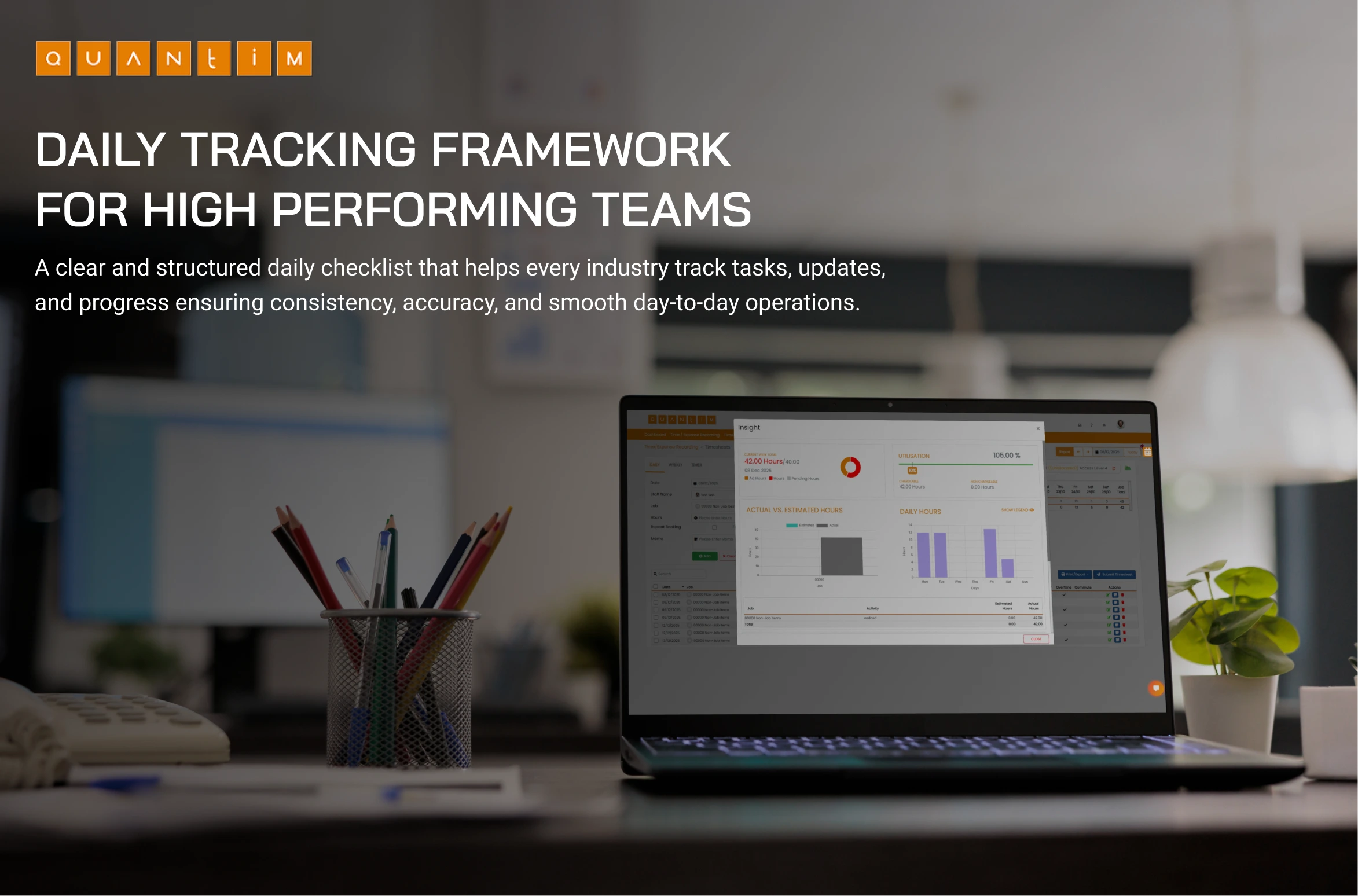
Quantim helps teams in all industries maintain strong daily habits by providing structured time tracking, task progress updates, activity level reporting, centralised communication, issue and risk logging and clear visibility across workloads and deadlines. Instead of juggling multiple systems, teams record everything in one organised platform that keeps daily information accurate and aligned.
This makes daily tracking easier, faster and more reliable, while improving planning and long term performance.
Conclusion
A daily tracking framework strengthens clarity and accountability in every organisation. By capturing the small details consistently, teams prevent delays, make better decisions and build a predictable rhythm of work. With the right structure in place, leaders always have an accurate picture of what is happening, what is changing and what needs attention. If your organisation wants smoother operations and stronger visibility, a daily tracking routine supported by the right tools can make a powerful difference.