
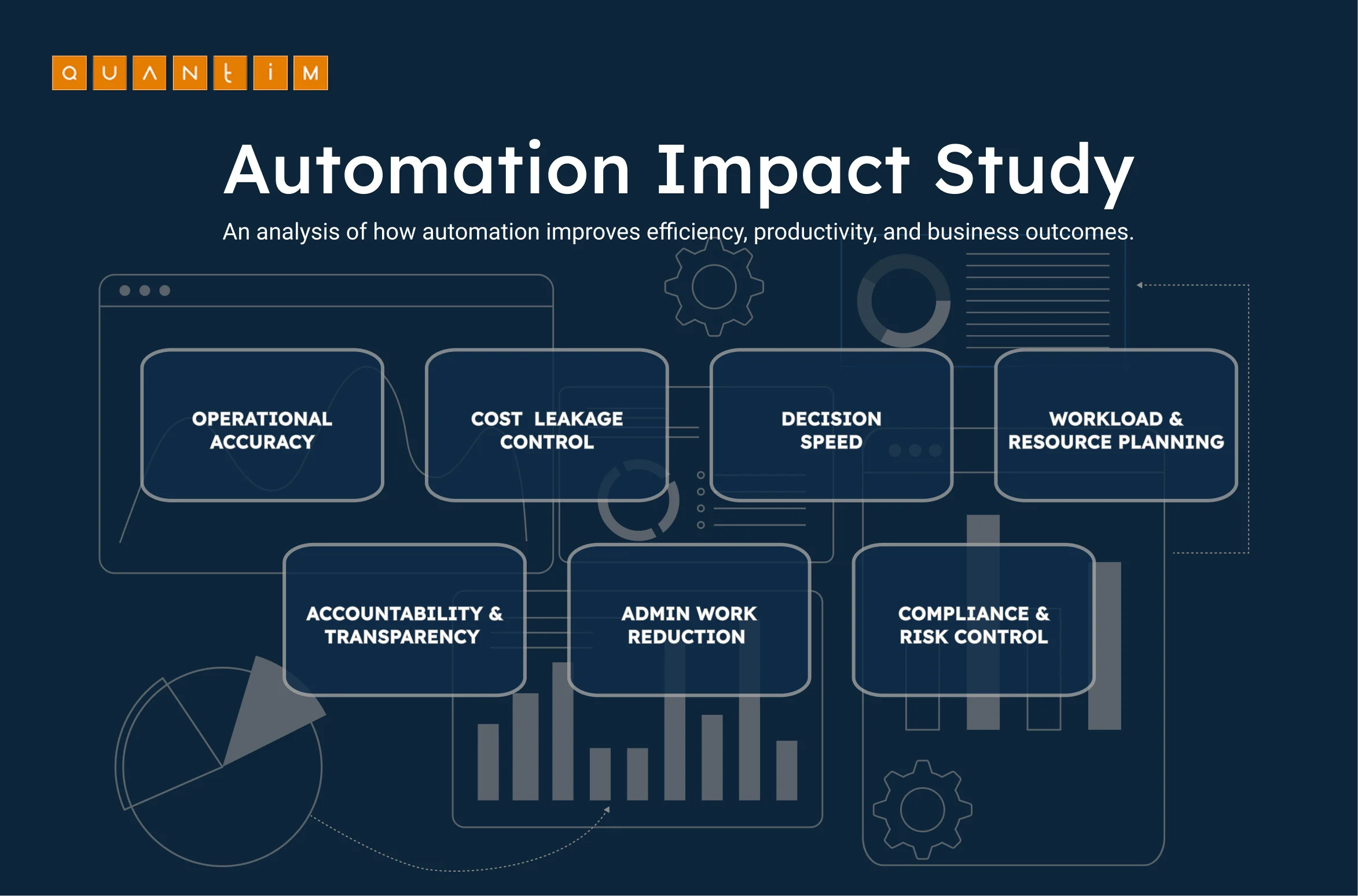
Automation has become one of the most influential drivers of operational efficiency in modern organisations. As companies face increasing pressure to deliver faster, reduce cost, minimise risk and operate with precision, manual processes can no longer keep pace.
This Automation Impact Study explores how organisations benefit when key workflows are automated. Instead of relying on spreadsheets, emails and informal communication, automation introduces structure, consistency and real time visibility that strengthens performance across every department.
The findings below reflect trends observed across multiple industries, including engineering, EPC, architecture, consulting, education, technology and professional services.
1. Automation Improves Accuracy Across Operational Workflows
Manual processes are vulnerable to human error. Delayed updates, forgotten tasks, inconsistent reporting and missing documentation create gaps that weaken performance. Automation removes these inconsistencies by ensuring that critical data is captured correctly and on time.
Observed impact:
- Higher accuracy in time recording
- More reliable progress tracking
- Reduction in duplicated or missing data
- Clean audit trails for every update
- Consistent reporting formats across teams
When teams adopt automated workflows, the quality of operational data increases significantly, which directly improves decision making and accountability.
How Quantim contributes
Quantim automates time capture reminders, progress updates, variation logs, field reporting and WIP processes. This ensures accuracy without placing extra administrative burden on teams.
2. Automation Reduces Cost Leakage and Financial Drift
One of the largest impacts of automation is the reduction in cost leakage. When activities, changes and delays are tracked manually, financial performance becomes difficult to interpret. Automation ensures that cost related information is captured consistently, allowing organisations to identify overspend early.
Observed impact:
- Reduction in unrecorded labour
- Fewer undocumented variations
- Decline in avoidable rework
- Stronger alignment between budget and actual cost
- Real time cost visibility instead of month end discovery
Organisations that automate their cost control processes typically achieve improvements within the first few months due to earlier detection of drift.
How Quantim contributes
Quantim connects daily activity updates, labour usage, progress measurement and cost codes into one live dashboard. This gives leaders real time insight into financial performance.
3. Automation Speeds Up Decision Making
Operational decisions slow down when leaders wait for updates, collect information manually or interpret inconsistent data. Automation accelerates decision cycles by giving managers a clear, up to date view of what is happening.
Observed impact:
- Faster approval cycles
- Shorter reporting timelines
- Immediate visibility of risks
- Clear mapping of task dependencies
- Removal of delays caused by missing updates
When decision makers have reliable, automated data, they can act confidently and proactively.
How Quantim contributes
Quantim provides real time dashboards, automated alerts, structured workflows and seamless synchronisation between field and office teams.
4. Automation Strengthens Workload and Resource Planning
Resource utilisation is difficult to manage when activity updates and time entries are inconsistent. Automation provides clarity on how time is spent, where workloads are increasing and where capacity is available.
Observed impact:
- Better distribution of tasks
- More predictable deadlines
- Insight into under or over-utilised teams
- Reduced bottlenecks during critical phases
- Evidence based planning instead of assumptions
Automation creates a stable operational rhythm that improves both productivity and team satisfaction.
How Quantim contributes
Quantim shows real time utilisation across jobs, activities and teams, enabling organisations to forecast resource demand accurately.
5. Automation Enhances Accountability and Transparency
When processes are automated, responsibilities become clearer. Every update, decision or change is recorded, timestamped and traceable. This builds a culture of accountability across teams.
Observed impact:
- Stronger ownership of tasks
- Reduced miscommunication
- Clear history of decisions
- Better collaboration across departments
- Improved compliance with internal processes
Automation supports transparent operations where nothing is overlooked or forgotten.
How Quantim contributes
Quantim maintains a full audit log of time entries, progress updates, variations, rework and approvals. This ensures that every action has traceable context.
6. Automation Frees Teams from Manual Admin Work
Administrative work consumes a significant portion of time across organisations. Automating repetitive tasks reduces effort and allows teams to focus on value driven work.
Observed impact:
- Less time spent on spreadsheets
- Reduced admin workload for managers
- Faster reporting cycles
- More time allocated to core project work
- Higher employee productivity and morale
Automation enables teams to operate more efficiently without increasing workload.
How Quantim contributes
Quantim automates daily reminders, data validation, WIP calculation, document capture and reporting, reducing manual input across all departments.
7. Automation Improves Compliance and Reduces Operational Risk
Compliance gaps often arise from inconsistencies in how tasks are recorded or monitored. Automation ensures adherence to established standards.
Observed impact:
- More consistent processes
- Reduced risk of audit issues
- Clear documentation for client claims and disputes
- Reliable history of changes and decisions
- Better control over safety and quality records
Organisations with automated workflows demonstrate higher operational resilience.
How Quantim contributes
Quantim enforces structured workflows and captures every update in a secure, controlled environment, supporting compliance across all project and operational activities.
Conclusion
Automation reshapes how organisations operate. It strengthens accuracy, reduces cost leakage, accelerates decision making and creates transparency across every department. When manual tasks are replaced with structured automated workflows, organisations gain predictability and clarity in their daily operations.
Quantim plays a key role in this transition by unifying time, cost, progress, field reporting, variations and WIP into one automated platform. This reduces risk, improves financial performance and allows teams to operate with confidence.
If your organisation is exploring the impact of automation on cost control and operational visibility, connect with us at info@quantim.co.uk for more insights.